




How Sharp Is a Katana?

A real katana is sharp enough to slice cleanly through paper, shave arm hair, and cut through rolled tatami mats with a single stroke. It is not sharp enough to cut steel, stone, or another sword. Those are movie scenes, not metallurgy.
How sharp is a katana compared to tools you already know? It sits in the same sharpness range as a premium Japanese chef’s knife, but its curved edge is built for powerful draw-cuts, not kitchen prep. The real question for most buyers is not “how sharp can it get,” but how much sharpness you need for your intended use.
A functional katana is sharp enough to slice paper, shave hair, and cut rolled tatami cleanly. Most have an edge hardness around 58–62 HRC and an inclusive edge angle of about 20–40°. They are designed for soft-to-medium targets, not for cutting steel, stone, or other blades like in the movies.
What Does “Razor Sharp” Really Mean on a Katana?
Movies show katanas slicing through plate armor, stone pillars, and other swords. None of that is realistic. A katana is a precision cutting tool designed for soft-to-medium density targets (flesh, bamboo, tatami). Striking hard materials like steel or stone would chip or roll the edge on contact.
“Razor sharp” in a sword context does not mean the edge is as thin as a disposable razor blade. It means the microscopic apex is fine enough to initiate a cut instantly, while enough steel behind it (called “meat” or niku) keeps the apex from folding over during a real strike.
Is a katana sharper than a razor? In terms of raw apex thinness, typically no. A fresh razor blade has a finer edge. But a razor would shatter on the first impact with a rolled tatami mat, because it has no structural support.
A katana trades a small amount of apex fineness for the ability to cut repeatedly under force without deforming. That trade-off is what makes it a weapon rather than a grooming tool.
Two quick checks reveal whether a katana is properly sharp:
- Hold the edge under a bright light and look along it. A sharp apex shows no visible line of reflected light. Any thin white stripe along the edge means that section is dull or rolled over.
- Press the edge lightly onto a hanging sheet of printer paper and draw the blade. A sharp katana bites in and slices cleanly with almost no drag or tearing.
Is a Katana Sharper Than a Kitchen Knife or Longsword?
A katana and a high-end Japanese chef’s knife share similar steel hardness: both sit in the 58–63 HRC range, and both use relatively acute edge angles. The difference is in what the blade does after contact.
A chef’s knife pushes straight down or slides forward through food on a cutting board. A katana draws across a target in a long pulling arc, using its curvature to spread cutting force along the entire edge.
European longswords take a different approach. Their edges are typically ground at wider angles (roughly 40–50° inclusive) on softer steel (generally 45–52 HRC), giving them a tougher, more impact-resistant profile. That geometry reflects the demands of armored combat, where versatility, thrust capability, and tolerance for blade-on-blade contact matter more than slicing precision.
Here is how the three blade types compare on the key sharpness variables:
| Blade Type | Typical Edge Angle (inclusive) | Edge HRC | Primary Cut Style |
| Katana | 20–40° | 58–62 | Draw-slice |
| Japanese chef’s knife | 20–30° | 58–63 | Push/pull slice |
| European longsword | ~40–50° | ~45–52 | Chop/thrust |
The longsword prioritizes mass and versatility over slicing precision. For a full breakdown of how these two designs diverge in weight, technique, and battlefield role, see the katana vs longsword comparison.
What Makes a Katana Edge So Sharp?
Peak katana sharpness comes from two systems working together: the physical geometry ground into the blade, and the internal steel structure created by heat treatment. Neither one produces a functional edge on its own.

How a Katana’s Edge Angle and Convex Shape Create the Cut
The standard sharpening angle for a katana is 10–20° per side, which creates a 20–40° inclusive wedge (the total angle when you add both sides together) at the cutting edge. That range is acute enough to initiate a clean slice through soft targets, but wide enough that the apex does not immediately fold over on impact.
Behind the edge, most katanas use a convex profile called niku (literally “meat” in Japanese). Instead of tapering to the edge in a straight V-grind, the blade swells slightly before narrowing to the apex. This convex shape serves two functions:
- It adds structural material directly behind the cutting edge to resist chipping
- It reduces drag during deep cuts by pushing material aside instead of wedging against it
The blade’s curvature adds a third factor. When you swing a katana in a proper draw-cut, the curve ensures the edge contacts the target at a shallow angle and slides along it. This spreading of force is what gives the katana its distinctive clean, pulling slice.
Terms like ha (cutting edge) and mune (spine) describe the different zones of this geometry. For the full vocabulary, see the parts of a katana guide.
How Forging and Polishing Make a Katana Sharper
Traditional katana forging uses differential hardening to create two distinct steel structures in a single blade. The idea is straightforward: make the cutting edge hard so it holds a fine apex, and keep the spine softer so it absorbs shock instead of snapping. The process works in stages:
- The smith coats the spine with a thick layer of clay and leaves the edge exposed or thinly coated
- The blade is heated and quenched in water
- The exposed edge cools rapidly and transforms into martensite, a hard crystalline structure that holds a fine cutting apex
- The insulated spine cools slowly and remains as pearlite, a softer structure that flexes under impact
The visible hamon line on a polished blade marks the physical boundary between these two zones. It is not decorative paint or etching. It is the actual transition line where the steel’s crystal structure changes from hard to soft.
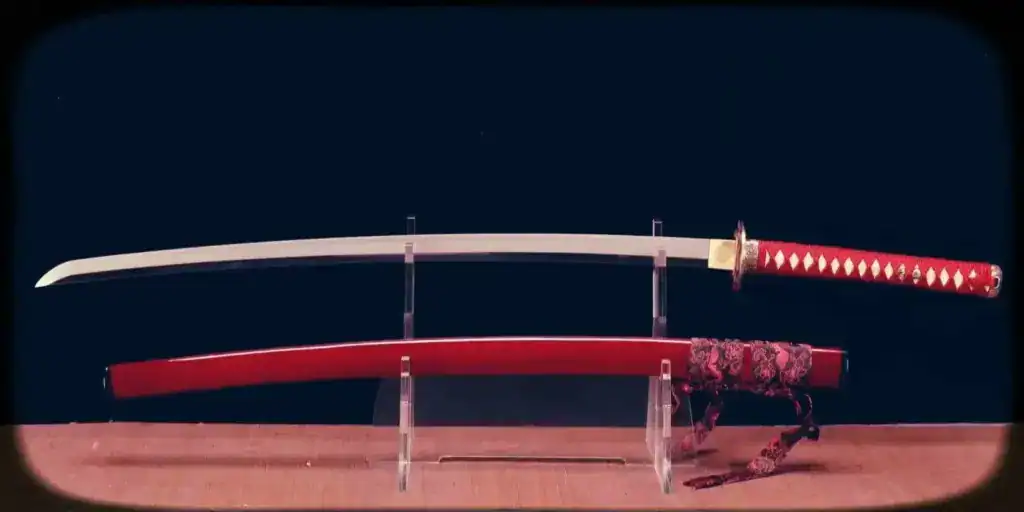
After hardening, the polisher takes over. Using natural water stones graded from coarse (around 220 grit) to fine (over 3000 grit), the polisher removes material in controlled passes until the edge apex narrows to an extremely fine cutting width. This final stage is what brings a properly hardened blade from “functional” to “hair-shaving sharp.”
In plain terms: a katana feels sharp because it combines a fine edge, hard steel at the cutting zone, and enough convex support behind that edge to keep it from collapsing in a cut. Remove any one of those three, and the edge either dulls instantly or chips on contact.
Why Some Katanas Stay Sharper Longer Than Others
How sharp a katana stays over time depends primarily on carbon content and heat treatment quality. Not all steels are equal, and the differences show up clearly in real cutting use.
Here is how the common katana steels compare for sharpness and edge retention:
| Steel | Sharpness Potential | Edge Retention | Forgiveness | Best For |
| 1045 | Moderate | Low | High | Display, beginners |
| 1060 | Moderate–good | Moderate | High | First functional katana, light practice |
| 1095 | High | High | Low | Serious cutting, tatami practice |
| T10 | High | Very high | Low | Repeated tameshigiri, competition |
Lower-carbon steels like 1045 and 1060 are more forgiving of imperfect technique. They flex and absorb impacts that would chip a harder blade. The trade-off is that their softer structure dulls faster under the same workload. For a beginner still learning proper form, that trade-off is often worth it.
High-carbon steels like 1095 (0.95% carbon) and T10 (1.0% carbon with added tungsten) support harder cutting apexes that resist deformation through repeated use. A well-treated 1095 blade tends to retain a working edge through regular tatami cutting sessions better than a 1060 blade under the same conditions.
Higher carbon does not automatically mean “better for everyone.” A 1095 blade sharpened to a very acute angle by someone who never maintains it will chip and perform worse than a well-maintained 1060 blade with healthy niku.
For a full comparison of how different steels perform across hardness, toughness, and edge retention, see the best steel for katana guide. Practitioners looking for maximum edge retention can start with high carbon steel katana options, where the steel choice directly reflects the HRC and geometry discussed here.
Why a Sharper Edge Is Not Always a Better Katana
An edge ground to the thinnest possible apex will slice paper effortlessly and score well on sharpness tests. It will also chip or roll the first time it contacts a dense target like bundled bamboo or a poorly positioned tatami mat. A thinner apex has less material to absorb impact energy, so it deforms faster.
Most functional katanas ship with what makers call a “working edge”: a profile with enough convex niku to survive the repeated stresses of real cutting practice. This edge might not shave arm hair as effortlessly as a freshly stropped razor, but it performs consistently across many cuts without mid-session touch-ups.
Chasing the absolute thinnest edge is useful for light-target demonstrations where the blade contacts only thin paper or suspended silk. For anything involving denser material or repeated use, that extreme keenness becomes a liability. A katana that dulls after three cuts is less functional than one that stays at “good sharp” for thirty.
How to Tell If a Katana Is Functionally Sharp
Three tests give you a reliable picture of how sharp a katana is without specialized equipment. If you are testing a blade you own, work in a well-lit area with no distractions, and keep your fingers away from the edge at all times.

- Paper slice: Hold a single sheet of printer paper by one corner and draw the blade through it with minimal pressure. A sharp edge cuts silently with a clean line. Tearing, catching, or sawing pressure means the edge is dull or poorly finished.
- Hair test: Rest the blade’s edge lightly on the hair of your forearm and draw slowly. A sharp katana pops the hair cleanly with minimal pressure. If the hair bends or slides, the apex is not fine enough.
- Light test: Hold the blade edge-up under a bright light source and look along the cutting edge. A sharp edge is invisible at this angle. Any visible white line indicates a flat or rolled spot.
For those who want a standardized reference, the BESS (Brubacher Edge Sharpness Scale) measures the grams of force required to sever a calibrated test filament. Lower scores mean sharper edges. It is more common in knife testing than sword testing, but the scale gives a useful frame of reference:
| BESS Score | What It Means |
| 300–400 | Standard working edge (utility knife level) |
| 150–250 | Functional sharp (good chef’s knife territory) |
| 100–150 | Very sharp (premium Japanese knife territory) |
| 50–70 | Razor-level keenness (fresh razor blade territory) |
Exact BESS scores vary depending on testing conditions, blade geometry, and how recently the edge was maintained. The scale is best used as a general framework for understanding sharpness levels, not as a precise spec for comparing individual swords.
If you are buying a katana as a gift for someone who has never handled swords, a blade with a functional working edge (not razor-keen) is a safer and more practical starting point than an ultra-sharp competition edge.
Why Katana Sharpness Fades and How to Slow It Down
Every cut causes microscopic damage to the edge apex. On a hard, high-HRC blade, this shows up as tiny chips where sections of the brittle martensite fracture away. On softer blades, the apex rolls over and folds instead of chipping. Both processes dull the edge through different mechanisms.
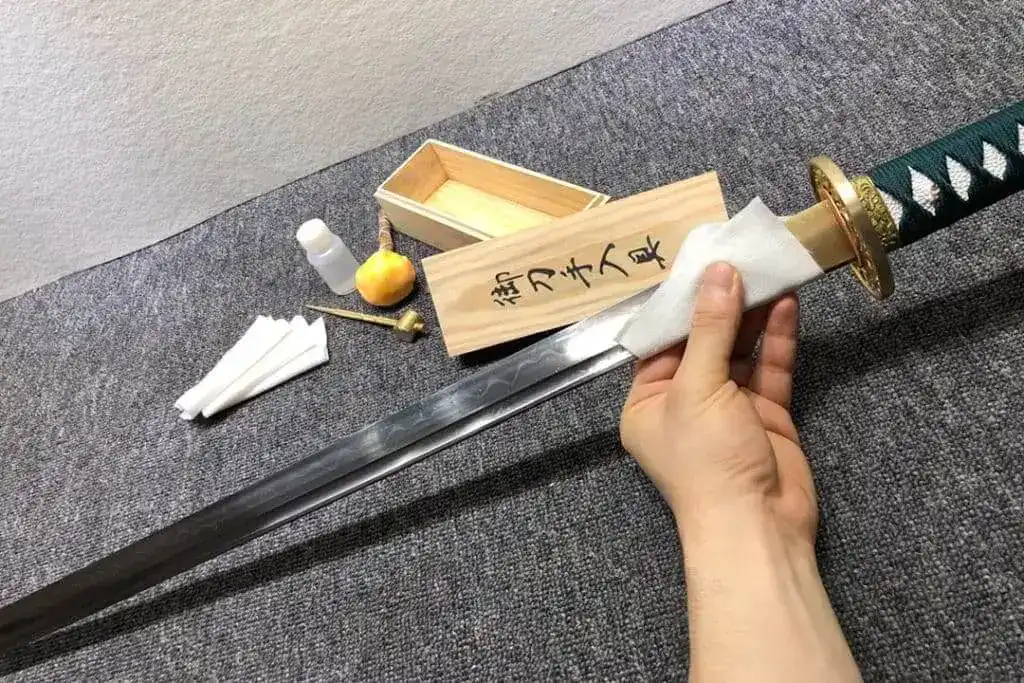
Environmental corrosion accelerates the problem. Humidity, fingerprint acids, and water residue from soaked practice targets all attack the thin steel at the apex faster than they affect the thicker body of the blade. An extremely fine edge left uncleaned for even a few hours can develop pitting that no amount of light stropping will fix.
Three habits slow this degradation significantly:
- Wipe the blade dry immediately after every use, including practice swings in humid conditions
- Apply a thin coat of choji oil (clove oil) or light machine oil to the entire blade surface before storage
- Store the katana horizontally in its saya (scabbard) in a climate-controlled space away from direct sunlight
High-HRC steel gives you a head start on edge retention, but consistent maintenance does more for long-term katana sharpness than any steel grade alone. For full step-by-step cleaning and storage instructions, see how to care for a katana.
Choosing a Katana with the Right Sharpness
Different uses call for different edge profiles. Matching the blade’s sharpness to your actual activity prevents both disappointment and unnecessary maintenance.
- First-time buyers: If this is your first real katana, choose a 1060 or entry-level 1095 blade with a balanced working edge. A forgiving steel lets you learn proper handling and maintenance without risking chips from imperfect technique. You do not need a razor-keen competition edge to enjoy and practice with a functional sword.
- Display collectors: A moderate factory edge on 1045 or 1060 steel is the practical choice. It keeps the focus on polish quality, hamon visibility, and overall finish without requiring the upkeep of a hard, keen edge that no one will use for cutting. Most display-quality katanas fall in the $100–$250 range.
- Dojo practitioners and light-cutting enthusiasts: A functional edge on 1095 or T10 steel with healthy niku gives the best balance of bite and edge retention. This profile handles regular practice on tatami and light bamboo without constant re-sharpening. Expect to spend $200–$500 for a well-made functional blade.
- Serious practitioners and competitors: Harder steels, stronger convex edge support, and the ability to specify preferred hardness and polish level make the difference at high training volumes. A custom katana build lets you match the sharpness profile to your cutting style, target material, and maintenance commitment. Custom builds typically start around $400 and go up based on steel and fittings.
Conclusion
Katana sharpness is not a single number or a pass/fail test. It is the combined result of carbon content, differential hardening, edge geometry, and expert polishing, all balanced against durability.
A blade that scores well on sharpness tests but chips on the third cut is less useful than one that stays at a reliable working edge through a full practice session.
The practical goal for most owners is a balanced edge: reliable cutting power with enough structural support to survive real use. Whether you prioritize display aesthetics, regular dojo practice, or competition-level cutting, the right sharpness profile exists for your situation.
Browse the full japanese katana collection to find a blade that matches your preferred edge profile and intended use.


