




What Can a Katana Really Cut Through? Bone, Steel & More

A well-made katana can cut through soft organic targets like tatami mats, bamboo, and bone, but it cannot cut through plate armor, gun barrels, rock, or thick steel. That gap between cinema and material science is significant.
The katana is a precision tool built for a specific category of targets, and its performance is strictly bounded by both blade construction and target properties. Whether you are choosing a sword for tameshigiri practice or simply curious about the physics, this guide works through each material category with the metallurgy and historical record behind each claim.
What Can a Katana Actually Cut?
Here is how each commonly asked-about target breaks down.
Designed to cut
- Soaked tatami mats
- Green bamboo
- Flesh and soft tissue
Possible, but with real blade cost
- Bone and joints (sometimes, with edge damage risk)
- Thin saplings under 1″
- Sections of dry hardwood (unlikely, high risk)
Not realistic
- Plate armor and chain mail
- Gun barrels
- Rock and concrete
- Car doors
- Another sword
The central framework is this: possible does not mean practical, and practical does not mean safe for the blade. A katana can complete a bone cut, but the edge often pays a measurable price. That cost matters when deciding what to cut in practice and what sword to buy for it.
Can a Katana Cut Through Bone?
Historical sword literature and tameshigiri (test cutting) records show that bone-cutting was part of how blade performance was evaluated in Japan. Swordsmiths documented results by cut type, treating bone density as a benchmark for blade quality.
That historical context does not mean bone is a suitable modern practice target, and it does not mean any cut comes without a cost to the edge.
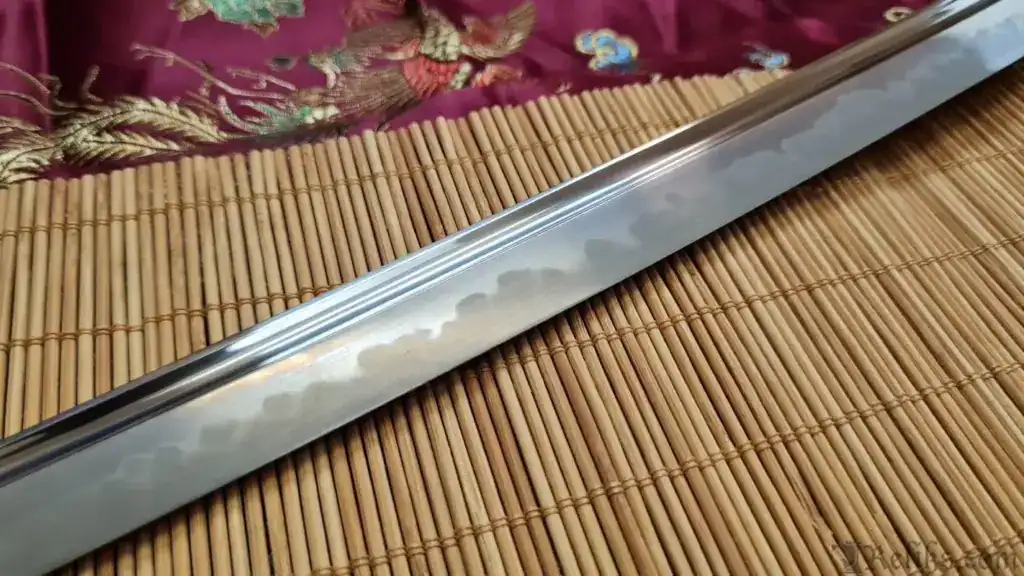
The challenge is what happens to the blade after the cut. Bone’s density and irregular shape concentrate stress on the edge during impact. Even a successful pass through a limb joint can leave the edge with small chips, a rolled tip, or, in severe cases, a crack along the blade.
High-carbon steel addresses this problem through the balance of edge hardness and spine toughness. The T10 and 1095 tool steels found in quality high-carbon steel katanas combine the hardness needed to bite through compact bone with enough flexibility in the spine to absorb the shock without fracturing.
Can a Katana Cut a Head Off?
In the ritual of seppuku (ritual suicide), the kaishakunin (designated second) cut through the dying samurai’s neck to end their pain quickly. Some historical accounts describe a technique called daki-kubi, where the cut was made to leave a strip of skin connecting the head, though how consistently this was practiced varies across sources and should not be treated as settled doctrine.
On the battlefield, samurai are recorded as having collected severed heads as proof of kills. Katanas were used in these contexts alongside other weapons, but simplifying that into “designed primarily as a decapitation tool” overstates the case. The sword had multiple battlefield roles; neck cuts were one documented use among many.
Can a Katana Cut Through Wood, Bamboo, and Trees?
The key distinction is fiber structure. Green bamboo and soaked tatami mats are the materials a katana can cut through most reliably, because their fibrous, water-rich structures yield cleanly to a slicing motion. Dense hardwood, especially when dry, compresses and grips the blade rather than parting around it. A tree is not just larger bamboo.
Bamboo and Tatami — What Katanas Are Made to Cut

Soaked tatami mats are the standard test medium in tameshigiri practice because their density closely mimics human flesh and bone. A clean cut through a rolled mat confirms both edge sharpness and correct hasuji (edge alignment), the two variables that determine whether a cut succeeds or stalls.
Green bamboo presents a different challenge. Its fibrous walls create real resistance that tests both the blade’s sharpness and the practitioner’s cutting mechanics. Unlike a mat, bamboo can flex slightly before it yields, making it a better stress test for technique without the blade risk that dense hardwood introduces.
Can a Katana Cut Through a Tree?
A katana cuts by slicing, not by chopping. Against a thick trunk, that distinction matters. The cross-grain fibers compress against the blade during a swing rather than parting around it, placing lateral stress on the blade that can cause it to bend or snap before reaching the far side.
Thin saplings under one inch in diameter fall into the “possible, but risky” category. Repeated cuts through green wood are also hard on the blade for a separate reason: organic sap left on the steel accelerates surface corrosion if not removed within hours of cutting.
After any wood-cutting session, blade cleaning and oiling should happen the same day. The how to care for a katana guide covers the specific steps for removing sap residue and protecting the polish without damaging the hamon (temper line).
Can a Katana Cut Through Steel and Armor?
“Metal” is not a single category. Hardened plate steel, chain mail, and industrial alloys each present different problems for a cutting blade, and a katana’s performance against each one is determined by different physical factors. Grouping them together produces misleading conclusions, so each deserves its own treatment.

Plate Armor and Chain Mail
Plate armor was specifically engineered to distribute impact force across its curved surface, redirecting slashes and trapping blade edges. A katana striking plate steel is unlikely to bite in cleanly, and the edge typically suffers more than the armor does.
Mail presents a different surface problem: interlocked rings tend to absorb and deflect cutting force rather than yield to it, especially when backed by a padded layer. This is why anti-armor fighting in both Japanese and European traditions emphasized thrusts into gaps rather than slashing through the rings themselves.
Samurai recognized this limitation and targeted gaps at joints, armpits, and neck openings, or switched to secondary weapons like spears and yari (pole weapons). This was not a weakness unique to the katana. European longswords faced the same problem against plate armor on their own battlefields, as covered in the katana vs longsword comparison.
Can a Katana Cut Through Another Sword?
When steel meets steel edge-on-edge, neither surface yields cleanly. Both blades sustain chips and cracks at the point of contact, and the blade that strikes fares no better than the one being struck. The cinematic image of one sword slicing cleanly through another does not survive contact with material science.
Traditional kenjutsu (Japanese sword combat art) addressed this directly. Practitioners are taught to receive an opponent’s blade on the spine or flat of their own sword, not the cutting edge. The edge is the most vulnerable part of the blade, and protecting it during contact is a core principle rather than a stylistic preference.
Can a Katana Cut Through a Gun, Bullet, or Car?
The common thread across guns, cars, and bullets is industrial manufacturing. Modern steel components are produced to tolerances and hardness levels that no handheld blade can overcome. The cuts seen in action films require the laws of physics to be suspended, not just a sharper sword.
Gun Barrels and Bullets
Gun barrels are made from hardened steel stock far thicker and harder than anything a katana was designed to engage. Cutting through a barrel in a single swing is not a question of blade quality; the material is simply beyond what a human swing through a slicing geometry can deliver.
Splitting a stationary lead bullet in a controlled test is sometimes cited as proof of extreme sharpness. Lead is soft enough that this is technically possible under fixed laboratory conditions. It has no relevance to battlefield use, and mid-air deflection of a fired round is not achievable by a human practitioner at any skill level.
Car Doors, Rock, and Concrete
Car doors are poor test targets for reasons beyond surface hardness. Even thin outer sheet metal sits in front of bracing, folded seams, and structural channels that the blade reaches almost immediately. The sword is likely to deform or snap at that contact point rather than cut through cleanly.
Rock and concrete act as a chisel against the blade rather than a target that yields to it. Striking either surface typically shatters the tip and destroys the edge geometry, often in a single contact. For blades not built around a full tang katana construction, the structural risk extends beyond edge damage to handle failure at the point of impact.
What Actually Determines a Katana’s Cutting Power?
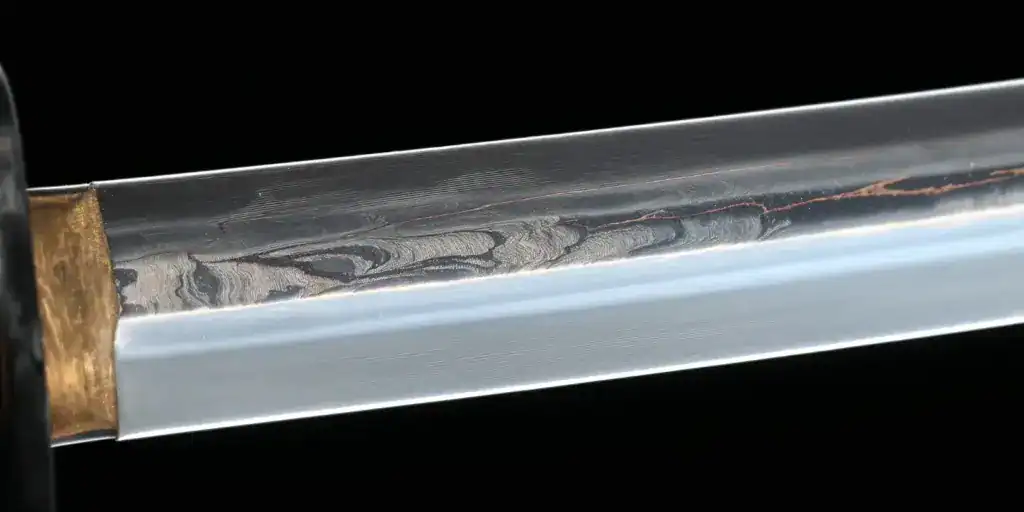
Cutting performance comes down to three interconnected factors.
- Differential hardening: Clay applied to the spine during heat treatment creates two distinct zones. The cutting edge reaches around 60 HRC (Rockwell Hardness, a standard scale for measuring steel hardness) in quality production blades, while the spine stays softer and more flexible, absorbing impact shock rather than transmitting it to the edge.
- Edge alignment (hasuji): The most critical variable in real use. A blade striking at even a few degrees off-axis will skew sideways during the cut, losing both power and penetration depth. Even premium steel typically performs poorly without consistent hasuji, which is why skilled tameshigiri practitioners spend years developing it.
- Construction and steel type: Decorative wall-hanger katanas are typically made from stainless steel with a rat-tail tang (a narrow rod inside the handle rather than a full-width blade core). These typically cannot survive a real cut, and attempting tameshigiri with one risks both blade failure and injury.
For cutting practice, the single most important purchase decision is choosing a sword forged from properly heat-treated high-carbon steel with a full tang. The best steel for a katana guide covers specific grades and how each one performs under cutting stress.
So What Can a Katana Really Cut Through?
The katana is a precision cutting tool for soft-to-medium organic targets. What a katana can realistically cut through is a much shorter list than Hollywood suggests, but within that range it performs well. Outside it, repeated contact with hard materials chips the edge, warps the geometry, and, in the worst cases, leaves the blade beyond practical repair.
For practice, soaked tatami mats and green bamboo are the right targets. They build clean cutting mechanics without unnecessary blade risk. Bone cutting is historically documented, but the edge cost makes it a poor choice for regular sessions.
What matters most before buying depends on why you want the sword:
- New to katanas or buying as a gift: The single most important call is decorative vs. functional. A wall-hanger stainless steel blade is not built to cut anything, and using it as one is the most common cause of blade failure and hand injury.
- Setting up cutting practice: Skip anything listed as a “display sword” or made from stainless steel. Entry-level functional katanas in 1060 or 1045 carbon steel typically start around $100 to $200, and mid-range japanese katana options in T10 or 1095 with a proper hamon run $200 to $400.


