




Through Hardened vs Differentially Hardened Katana: Worth It?

Most beginners see “differentially hardened” or “clay tempered” in a listing and read it as “better katana.” That is where people overpay. Those words matter only after you know whether the sword is for learning hasuji, or edge alignment, cutting clean tatami, or buying a blade because the hamon is the part you care about.
Start with through-hardened if this is your first functional sword or your edge alignment is still rough. Look at DH when a real hamon is the reason you are shopping and the seller gives you enough photos to check it.
Before ordering or cutting: check your local age, import, storage, and public-carry rules. This guide compares blade construction, not legal permission to own or use a sword. Laws vary by country and state. Confirm what applies where you live before you buy.
Through-Hardened or DH: Practice Blade or Hamon Blade?
| What matters | Through-hardened (TH) | Differentially hardened (DH) |
| Best fit | First sword, repeated practice, learning hasuji | Hamon-first buyers, clean cutters, display-first owners |
| Why pick it | Survives more beginner mistakes | Gives you natural hamon and stronger edge bite |
| What you give up | No natural hamon, and usually less edge hardness | A bad twist can leave a set bend |
| Hardness pattern | More even from ha to mune, edge to spine | Harder ha, softer mune |
| Price clue | Costs less; check steel and construction | Costs more; cheap “DH” needs photo proof |

What Heat Treatment Really Changes
Heat treatment changes how a katana fails when the cut is not perfect. It does not rescue vague steel, poor geometry, a weak tang, loose fittings, or sloppy sharpening. A well-made TH blade in named steel is usually a better first practice sword than a DH blade with no real construction details.
Through-Hardened Blades: More Forgiving
A TH blade is hardened more evenly from edge to spine. When your hasuji is a little off on a soft target, a good TH blade is more likely to flex and come back straight than a DH blade built with a softer spine.
Through-hardened is not code for low-end. A 1060 or 9260 TH katana with a proper nakago, tight tsuka fit, a clean edge, and decent geometry can be a real practice sword. The flaw is visual: no natural hamon. For practice, that is usually the right trade.
Differentially Hardened Blades: More Hamon, Less Flex
A DH blade is hard at the edge and softer through the spine. On clean cuts, that harder edge can hold bite longer. The softer spine is also why a bad twist can leave a set bend. That change in hardness is what gives you a natural hamon instead of an etched line.
The method sellers call “clay tempered” works like this: clay is packed thicker along the spine before quenching, so the spine cools slower and stays softer while the exposed edge hardens. The phrase still needs proof in the listing: close hamon photos, named steel, and hardness framed as edge versus spine.
What a Real Hamon Should Show
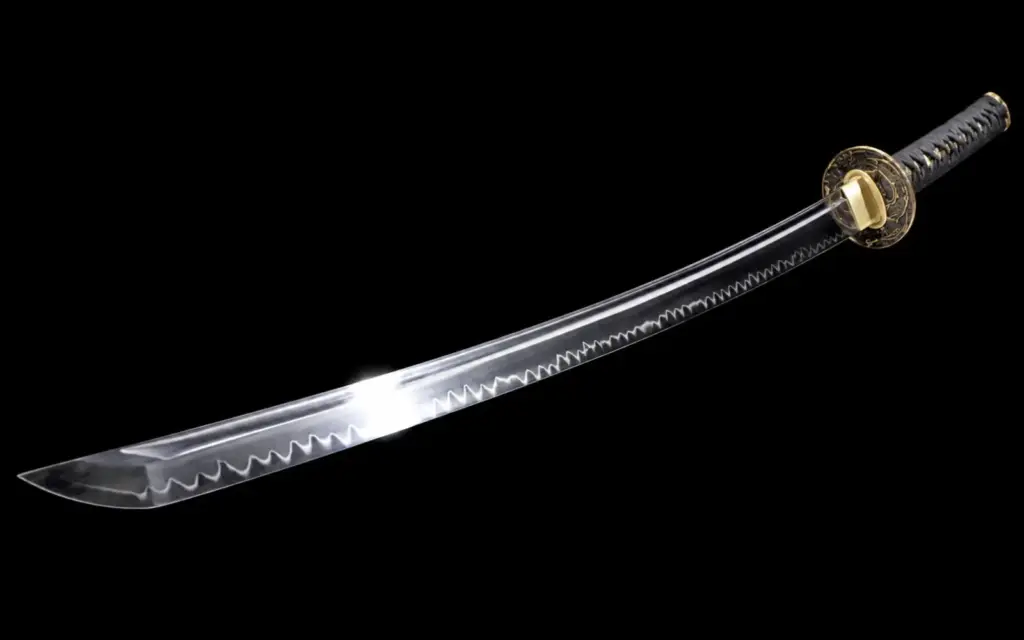
A real hamon is a heat-treatment record you can see: an uneven transition with activity such as ashi, nie, or nioi running along the blade. It is not a crisp painted line or a brushed-on stripe. A perfectly smooth, identical wave from machi to kissaki should make you suspicious.
A real hamon can reflect differential hardening, but it does not prove the blade was made in Japan, made traditionally, or built well. Ask for photos in normal light instead of judging from dramatic product shots alone. For many collectors, the look is enough; just do not treat the hamon as a quality guarantee.
How Each Katana Handles Cutting
On soft targets with clean technique, both hardening styles can cut well. The difference shows up when the mat is tougher than expected, your angle is off, or the blade catches and twists.
Sharpness and Edge Life
A DH edge, often around 58 to 62 HRC, can stay sharp longer through clean tatami cuts. A TH blade usually gives up some edge hardness for better recovery. Niku, the blade’s convex edge geometry, and the initial polish still matter as much as the number on the listing.
Flex and Permanent Bends
TH blades tend to be springier. A small hasuji mistake on a soft target is less likely to leave a permanent bend than it would on many DH blades. A DH blade is not built for uniform spring-back; if it twists hard enough, the softer spine can take a set.
Chips and Wrong Targets
Harder edges chip more easily. A DH blade pushed into dry hardwood, metal, or stone is more likely to take edge damage. Bamboo is not a casual beginner target. Cut prepared targets only when the sword is rated for it, the space is controlled, and your technique is not guesswork.
Check what a katana can safely cut before you judge a blade by steel or hardening method.
HRC: A Range, Not a Score
For production katanas, DH listings often claim a harder edge and softer spine, while TH blades are usually closer to one hardness through the blade. Treat those HRC ranges as seller shorthand, not lab data.
If You Are Still Split
| If this sounds like you | Start here |
| First sword, soft targets, or rough hasuji | Through-hardened |
| Dojo or supervised tatami practice with reliable hasuji | Either, if the sword is built and sharpened well |
| You mainly want visible hamon activity | Differentially hardened, after checking the listing photos |
| Metal, stone, trees, or destructive testing | Neither |
Your First Functional Katana
Your first functional katana should usually be through-hardened. Do not buy the cheapest TH blade just because it says “functional.” Look for named steel, a proper nakago rather than a rat-tail tang, tight tsuka fit, a clean edge, and a seller who states the sword is meant for cutting.
Start by comparing 1060 steel options for beginners. If you expect ugly early cuts while you learn hasuji, compare 9260 spring steel blades too. Then check geometry, heat treatment, and the seller’s cutting-use notes before deciding.
Pay for DH When Hamon Is the Point
Choose differentially hardened when the hamon is the point of the sword, not a bonus word in the title. You should already be comfortable choosing targets and keeping your edge aligned.
The extra cost should buy proof: close hamon photos, edge-versus-spine hardness framing, and enough product detail to show the seller knows the blade. If the listing only says “clay tempered” and shows one glossy full-blade photo, keep looking.
Moving from TH to DH is not upgrading from bad to good. It is trading forgiving practice behavior for hamon, edge feel, and traditional-style visual character. If you already own a TH practice sword that cuts well, a DH blade is mainly a visual and tactile upgrade. Chasing more durability instead? Stay with spring steel.
When real hamon is the priority, start with T10 blades worth comparing. Then zoom into the listing photos before you decide the price is fair.
How to Read a Katana Listing
Katana listings often stack terms until the sword sounds better than the photos prove. “Battle ready,” “high carbon,” “clay tempered,” and “real hamon” are not proof. Before paying more, look for the steel name, tang construction, close hamon photos, tsuka fit notes, and stated cutting use.
Katana Claims to Double-Check
- “Through-hardened” should come with named steel, proper nakago, and stated cutting use.
- “Clay tempered” should come with close hamon photos, steel name, and edge-versus-spine hardness detail.
- “Real hamon” should show organic activity in close-up photos, not one smooth decorative line.
- “Battle ready” means nothing unless the listing also shows proper nakago, named steel, and tight fittings.
- “High carbon steel” is too vague unless the seller names the grade, such as 1060, 9260, T10, or 1095.
Signs the DH Claim Is Real
A credible DH listing shows hamon photos with visible activity: irregular wave patterns, ashi, or other texture that changes along the blade. It also describes hardness as a range and separates edge from spine. One polished glamour shot is not enough.
Price is another clue. A T10 katana priced like a 1045 wallhanger from the same seller deserves more scrutiny. For photo examples, start with real hamon vs fake hamon.
Three Claims That Should Make You Pause
- “Through-hardened with real hamon.” A through-hardened blade cannot naturally produce a real hamon. A cosmetic hamon is not differential hardening. If the listing does not explain the contradiction, move on.
- An exact HRC number with no steel or context. Hardness without steel type, geometry, and intended use is a number on a screen, not a performance promise.
- Toughness, sharpness, and tradition, all promised with no steel or heat treatment named. The listing is selling adjectives. Trust sellers who show the steel, construction, and use limits.
Pick Steel After You Pick the Job
After you choose the hardening style, steel is the next filter. The best steel for katana guide compares materials in more detail.

Rough Practice or Frequent Backyard Cutting
Stay with forgiving heat treatment. 9260 and 5160 are the durability-minded options, but a tougher blade is not permission to cut whatever is nearby. Bad targets still damage good swords.
When Hamon Comes First
T10 or 1095, but only after you accept that the blade will be less forgiving. If you already own a TH practice sword that cuts well, this move gives you real hamon, a harder-feeling edge, and traditional-style character. It will not fix bad hasuji.
Practice-first: shortlist 1060 or 9260, then check nakago, tsuka fit, geometry, and cutting-use notes. Hamon-first: shortlist T10, then verify hamon photos before paying extra.


