


Types of Japanese Swords: Katana, Tachi, and Related Terms

Japanese sword names get confusing because they do not all describe the same thing. One may name the blade form, another the mounting or period, and another a pairing or training item.
Begin with the blade itself. Once you know the form, you can tell whether the next term changes the classification or simply adds context.
The main Japanese sword forms
Katana, tachi, wakizashi, tanto, and odachi or nodachi are the most useful starting forms for beginners. They run from short blade to extra-long sword, although they do not cover every recognized form.
Names such as nihonto, daisho, and iaito belong to different naming systems. They refer to collector context, a pairing, or training equipment, rather than five additional blade shapes.
The useful first question is whether a word names the blade itself. A term that does not name the blade may still matter to a collector or buyer, but it will not tell you which of the five forms you are looking at.
Five Japanese sword forms to know first
These measurements refer to blade length, not total sword length. When names overlap, mounting and carry style can matter more than a number.
Use the table for a quick first pass. The Japanese writing helps when a listing uses the original term; the profiles explain the cases where length or mounting overlap.
| Form | Japanese writing | Approximate blade length | Best beginner identifier |
| Katana | 刀 | Generally over about 60 cm / 24 in | Curved long blade, commonly worn edge-up |
| Tachi | 太刀 | Usually a long blade; mounting is more useful than a fixed range | Suspended edge-down mounting on mounted examples |
| Wakizashi | 脇差 | About 30-60 cm / 12-24 in | Short companion sword |
| Tanto | 短刀 | Generally under about 30 cm / 12 in | Dagger-length Japanese blade |
| Odachi / Nodachi | 大太刀 / 野太刀 | Often described as over about 90 cm / 36 in; usage varies | Clearly oversized long blade |
Katana: the familiar long sword

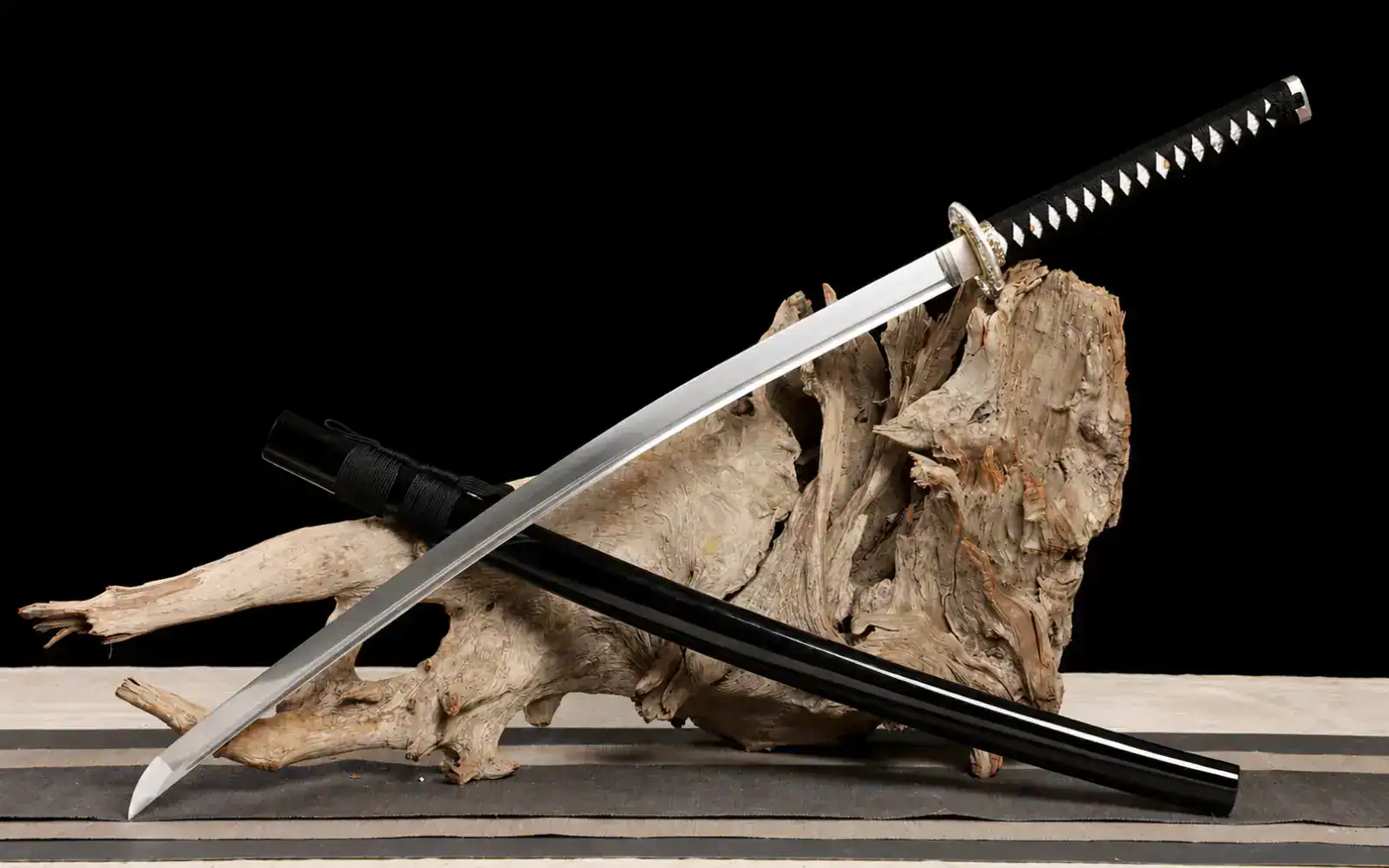
A katana is a Japanese long sword generally recognized by its curved, single-edged blade and edge-up carry style. English speakers sometimes use “katana” for any Japanese sword, but it is one form in a broader family.
Steel, construction, heat treatment, and intended use describe other aspects of a katana. They matter when comparing katana, but they do not name separate Japanese sword forms. An English-language listing can use “katana” as a broad label while its details point to a narrower question. For that comparison, see different types of katana.
Tachi: the suspended edge-down long sword

A tachi is a Japanese long sword commonly associated with suspended, edge-down mounting and carry style. On a mounted example, that is a useful cue. Length can overlap with katana, so a tape measure cannot settle the question on its own. Nor can the current mounting settle the history of a remounted blade.
Some listings use traditional cavalry-sword language. Read that as historical context, not a fixed role for every tachi.
When a listing uses both names, check the mounting before treating length as the deciding cue. The dedicated tachi vs katana comparison takes that question further.
Wakizashi: the short companion sword
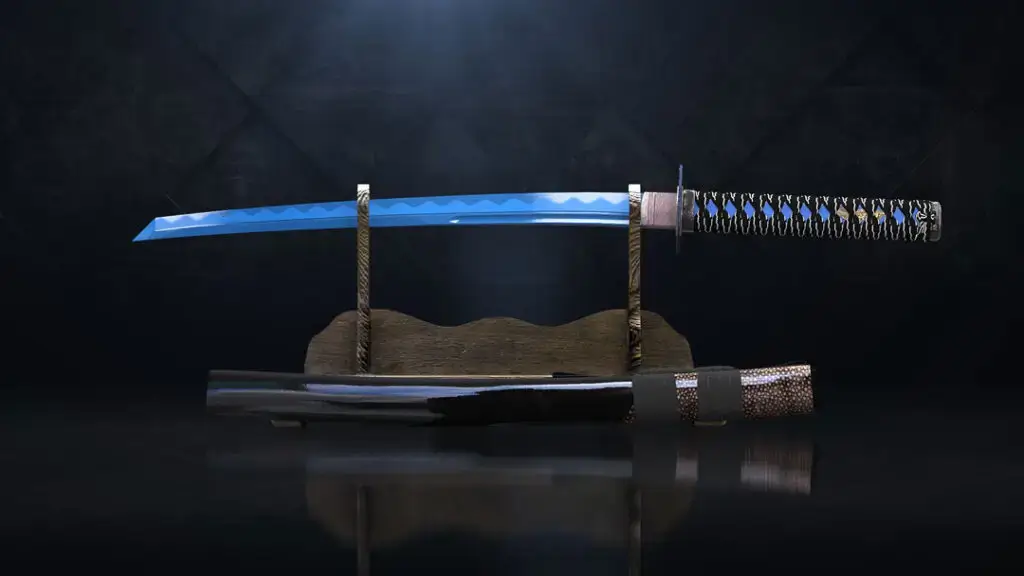
A wakizashi is a Japanese short sword, generally shorter than a katana and often associated with the daisho pairing. Its usual blade-length shorthand places it between tanto and katana. That range is a scale cue, not its whole definition. Being shorter does not make it a small katana.
Daisho describes a long-and-short pairing, not the wakizashi form itself. A wakizashi can stand on its own in a collection, and two pieces do not become a historical pair simply because one is long and one is short.
Tanto: the compact Japanese blade

A tanto is a Japanese short blade or dagger, generally recognized by a blade length below about 30 cm. “Dagger” is useful English shorthand, but tanto is still a standard Japanese blade form.
Size is a clue, not a form name by itself. Check the listed blade length and description instead of assuming that every Japanese-style dagger is a tanto. For this check, blade length is more useful than total mounted length.
Odachi and nodachi: extra-long swords

Odachi and nodachi are names commonly used for extra-long Japanese swords, although the exact historical distinction varies by source and context. Modern retail and enthusiast usage often groups the two names together, so a product title may not settle the historical terminology.
For a beginner, they are the extra-long outliers, not ordinary katana with a little more length. The clearly unusual blade length is the first clue. Total mounted length is the next practical check before you think about storage or display.
Check the listed blade length and total mounted dimensions before planning wall space, storage, or a collection display. The sword name alone cannot answer those space questions.
Earlier and special Japanese sword forms
These forms broaden the map without changing the starting five. They matter when a listing is straight-bladed or has an unusually long handle, two signs that should stop you from filing it under katana by default.
Earlier straight-bladed forms
Chokuto is an earlier straight-bladed Japanese sword form that predates the familiar curved katana and tachi shapes. Tsurugi, also called ken, is a straight, double-edged form associated mainly with earlier and ceremonial contexts.
Neither form fits the familiar curved, single-edged picture many readers have in mind.
Other historical and special forms
Kodachi does not fit a simple modern length rule. Nagamaki is a long-handled bladed weapon near the boundary between sword and polearm, so handle proportion matters as much as blade length.
For either one, compare blade form, mounting, and handle relationship before placing it in a familiar category.
How related Japanese sword terms work
The terms below are not extra blade shapes. They name historical context, a pairing, training equipment, or a collector label. Once you know what a term describes, you can keep it from replacing the form name.
Historical form and military categories
Uchigatana is a historical form term closely related to katana, not one of the five main forms in this guide. Gunto is a military-era category that needs its own historical and collecting context. Neither term works as a quick substitute for the form labels in the table above.
Umbrella, pairing, and English labels
Nihonto is a collector term, not the name of one blade shape. It can include several forms, so use a separate form name when comparing listings. The term can add collection context, but it cannot replace katana, tachi, or another form name. See nihonto vs katana for the distinction.
Daisho names a long-and-short pairing. It describes how two swords relate, not a new blade form or proof that the two pieces share one history. “Samurai sword” is an informal English label that can refer to a katana, tachi, wakizashi, tanto, or another named form.
Training, blade status, and adjacent weapons
For iaido or kendo, these names describe training equipment or blade status rather than another sword form. Iaito is an unsharpened metal practice sword typically used for iaido. Shinken describes a real or sharpened blade designation, so confirm the listed edge condition and training suitability on the product page.
Bokken is a wooden training sword, and shinai is a bamboo practice weapon used in kendo. A naginata is a polearm, even when a store lists it beside swords for browsing. That distinction matters when you are trying to choose a sword form rather than an adjacent weapon.
Ninjato or shinobigatana is a modern, pop-culture-adjacent label whose historical status is debated. Do not treat it as proof of one settled historical form.
Terminology note: Use the length ranges and carry cues as a starting point. A museum collection record can help clarify the form and mounting of a specific historical sword.
Browse by sword form
Once you know the form, open the matching category. The product page still tells you whether an individual sword is sharp, suitable for training, and sized for your space. It is also where you can check construction and intended use.
On a tachi listing, compare the mounting photographs with the blade measurement. For any mounted sword, check the overall dimensions before planning storage or display.
- If the familiar long-sword form is your starting point, look at katana.
- To compare the suspended, edge-down form, look at tachi.
- For shorter companion swords, see wakizashi.
- For compact Japanese blades, see tanto.
- To compare odachi or nodachi labels with other long blades, or to weigh several forms at once, browse Japanese swords.
Start with the form, then read the label
Identify the blade form first, then separate it from terms about provenance, pairing, training, military period, or adjacent weapons. Katana is the best-known Japanese sword form, but it is only one part of the larger group.
Then compare the mounting and dimensions with the product description. Follow that order whenever a listing uses several Japanese names at once. It gives you a clearer starting point for collection research or category browsing.


