




Are Amazon Katanas Safe?

Quick Answer
- Amazon katanas can be fine for display, gifts, or cosplay, but the listing alone does not prove a sword is safe for cutting.
- Treat a marketplace katana as display-only unless the exact variant proves named steel, heat treatment, tang construction, intended use, and seller support.
- Do not test-cut with a questionable sword to see what happens. Inspect the build, ask the seller, or return it.
Amazon makes katana shopping feel simpler than it is. A wall-hanger, an anime replica, and a sword advertised for cutting can sit side by side with similar photos, star ratings, and title words.
Amazon is not the problem by itself. Guessing from photos and seller language is the problem. The exact variant has to show the use case, steel, heat treatment, handle construction, seller proof, and return path.
Decide What This Katana Is For
Start by deciding what job the sword has to do. A listing that is acceptable for a wall display can still be wrong for backyard cutting, dojo-adjacent practice, or a gift recipient who may swing it.
- Wall display is the safest Amazon fit when the listing shows size, material, mounting, shipping, and returns.
- Cosplay and photos usually call for dull or non-contact options; many events ban metal props even when ownership is legal.
- Gifts should avoid sharp unknown swords unless the recipient already knows how the sword will be stored and used.
- Collectors should judge polish, fittings, saya condition, and seller transparency before caring about cutting claims.
- Backyard bottles, fruit, and tatami are still cutting use because the blade and handle take impact stress.
- Martial arts practice should follow instructor-approved equipment, especially for edge type, length, and handling rules.
Gift buyer rule: A sharp unknown marketplace sword is a poor surprise gift. Choose display-only, dull, or clearly documented options unless the recipient already has a safe plan for it.
Kato’s guide to choose a katana for practice or display separates wall pieces, training tools, and cutting expectations in more detail.
Five Proof Points Before Cutting
A marketplace katana should not be trusted for cutting unless five details line up on the selected item. One strong phrase, such as “full tang” or “hand forged,” does not carry the whole listing.
- Steel grade: Look for named steel such as 1060, 1095, T10, 5160, or 9260 on the exact option you selected.
- Heat treatment: Through-hardened, differentially hardened, or clay-tempered wording should appear with the steel claim.
- Tang construction: Full-tang or through-tang construction should be described, preferably with construction photos.
- Intended use: The seller should say display-only, light cutting, regular cutting, or practice equipment without hiding behind “battle ready.”
- Seller support: The seller should be identifiable, responsive, and clear about returns before you buy.
Missing one proof point means caution. Missing two or more means display-only or skip it for cutting.
Do Not Trust Sword Buzzwords
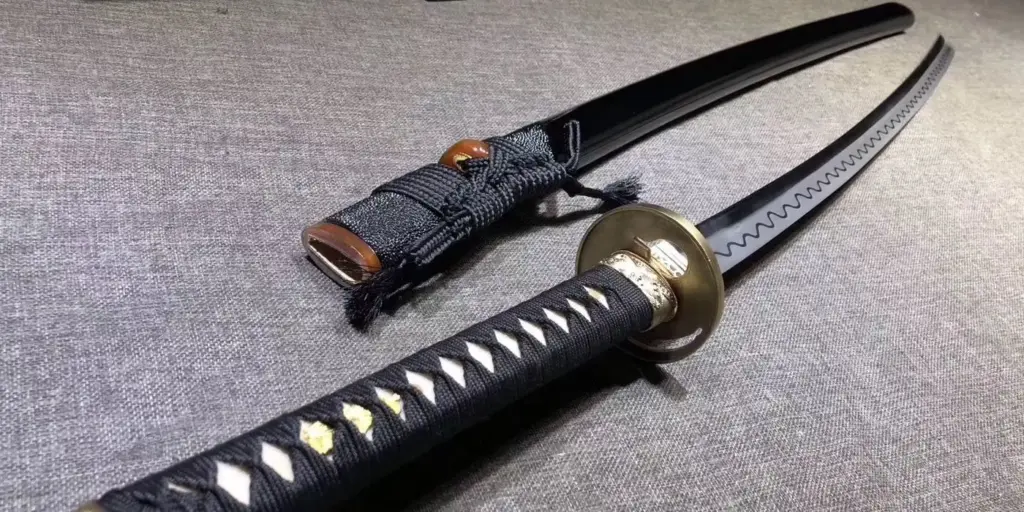
Marketplace listings often use sword terms as decoration rather than proof. “Battle ready” is not a safety standard. “Damascus” or “folded steel” may describe a visible pattern without proving the core steel, heat treatment, or cutting use.
A hamon can be a real result of differential hardening, but some listings use etched or cosmetic lines. Tamahagane, nihonto, shinken, and iaito are also not interchangeable. A shinken is a live blade, while an iaito is usually a blunt training sword.
You do not need to decode every Japanese term before buying. For cutting safety, check steel treatment, tang or nakago construction, tsuka fit, fittings tightness, blade condition, and seller transparency.
Material language can be misleading, especially around stainless steel and patterned blades. Compare carbon steel vs stainless steel katana before treating a steel label as a use guarantee.
Check Local Rules Before Ordering
This article is not legal advice. Sword ownership, shipping, import, public carry, event, age, and travel rules differ by place. Owning a sword at home is not the same as carrying it in public or bringing it through an airport.
- Buying online: check local possession rules, seller restrictions, and age requirements.
- US buyers: state and city rules can treat ownership, transport, and public carry differently.
- Importing: check customs guidance for your country before ordering across borders.
- Events: check cosplay, convention, and venue prop rules before carrying any metal sword.
- Flying: TSA guidance says sabers are not allowed in carry-on bags but may be checked.
- United Kingdom buyers: GOV.UK guidance restricts certain curved swords with blades over 50 cm unless an exemption applies.
Why Amazon Reviews Do Not Prove Safety
Amazon reviews often tell you whether a sword arrived on time, looked good, or made a fun gift. Those details help display buyers, but they do not prove that the handle will stay tight under impact.
Grouped product pages create another problem. A review may describe a different size, seller, sharpness option, color, blade material, or variant than the one in your cart.
Badges such as “Amazon’s Choice” or “Best Seller” should not change the safety test. They can help you spot popular listings, but they do not prove steel, heat treatment, tang construction, or cutting use.
Read low-star reviews before high-star reviews. Loose fittings, bent blades, mismatched items, cracked saya, sharpness confusion, packaging damage, and return complaints matter more than “looks cool.”
Red Flags That Mean Do Not Cut
Use these red flags as a pass or pause tool. One warning sign may justify a seller question. Several together usually mean display-only.
| Listing signal | Cutting verdict | Buyer move |
| “Battle ready” with no steel or tang detail | Fail | Treat as display-only. |
| Stainless steel sold for cutting | Fail | Use for display unless a reputable seller proves otherwise. |
| Named steel but no heat treatment | Caution | Ask the seller or choose a clearer listing. |
| Full-tang claim with no proof | Caution | Look for photos, construction notes, or seller documentation. |
| Cheap Damascus with no core steel detail | Caution | Treat the pattern as visual until proven otherwise. |
| Stock photos or repeated images | Caution | Verify the exact seller, model, and variant harder. |
A listing that clears the table is worth a closer look, not automatic cutting approval. You still need the exact seller, exact variant, and safe handling conditions to match your plan.
Many mistakes to avoid when buying a katana start with trusting a label before checking what it proves.
Cheap Cutting Claims Need Extra Proof
Price does not prove safety, but a very cheap functional claim deserves suspicion. A low-cost display sword can be reasonable decoration; a low-cost sword promising cutting use needs evidence before impact.
Not every inexpensive sword will fail. The problem is that an unverified sword gives you no reason to trust the blade, handle, and fittings under stress.
- Rat-tail tang failure: A narrow welded rod inside the handle can fail near the collar, allowing dangerous blade movement.
- Loose mekugi or handle fit: A loose pin, hole, or handle core can let the blade shift on impact.
- Poor heat treatment: A hard target or missed cut can bend, chip, or crack a blade that was not built for stress.
- Loose ito or poor grip: A shifting wrap can reduce control during a swing.
Even a dull metal sword can cause blunt-force injury if handled carelessly. Do not test a questionable sword on targets to find out whether it is safe.
Brand Names Still Need Seller Proof
A familiar production brand can make a listing worth checking, but it does not authenticate the exact seller, variant, condition, or construction. Treat the brand name as a reason to verify harder, not proof.
Verify the model name, seller identity, edge type, condition, and return terms. A brand name in the title is weak if the seller, variant, or condition is unclear.
Kato’s guide to the best steel for a katana compares material claims, while the full tang katana guide explains why handle construction matters.
Check the Exact Amazon Listing
Audit the listing before purchase, not after the sword arrives. You are checking whether the seller has earned your trust, not learning how to use the sword.
Use every part of the page: title, selected variant, bullets, specs, photos, Q&A, reviews, seller profile, and return terms. A claim that appears only in one place is weaker than a claim supported across the listing.
Check the Exact Variant
Check the selected size, blade type, seller, sharpness, and variation option before trusting reviews. Grouped pages can mix dull, sharpened, decorative, and differently sized swords under one review pool.
Check Steel and Heat Treatment
Steel name alone does not prove a sword is functional. Look for steel grade, heat-treatment language, and intended-use wording together, then compare the title, bullets, photos, and product description.
Check Tang Proof Safely
Before buying, look for photos or documentation that show full-tang or through-tang construction. Do not disassemble a sword unless you know how to inspect and reassemble it safely.
Check Photos Against Specs
Compare the title, bullets, photos, specs, Q&A, and product description for conflicts. Missing close-ups, generic stock photos, or images that do not match the selected variant should slow the purchase down.
Run a reverse image search when the photos feel generic. If the same sword image appears across many sellers or marketplace sites, verify the seller harder before treating the listing as reliable.
Ask the Seller Before Checkout
Ask the seller three questions when details are missing: Is this sword for display, light cutting, or regular cutting? What steel and heat treatment are used? How is the tang constructed?
Clear answers help. Vague buzzwords mean display-only or skip. No answer means skip it for cutting.
When an Amazon Katana Is Fine
Amazon is most reasonable when the sword’s job is display, photos, cosplay, or low-risk collecting. It is a weak default for regular cutting, dojo-adjacent practice, or a first functional sword when you cannot judge construction.
- Buy for display when the size, finish, sharpness, and return terms are clear.
- Consider cutting use only when the five proof points match the exact variant.
- Prefer reviews tied to the exact option, not vague appearance reviews.
- Avoid listings that depend only on “battle ready,” “hand forged,” or “full tang” without proof.
Display, photos, and non-contact cosplay are style-first uses. Kato’s anime and movie katana category fits that job better than a vague marketplace sword pretending to be cutting-ready.
What Clear Sword Listings Show
Better sword listings show the five proof points before checkout. After using the checklist, compare sellers by what they document, not by how hard the product title tries to impress you.
Kato’s katana category and 1060 Carbon Steel Japanese Sword options give buyers visible specs before checkout.
Already Bought One? Check It First
Do not test-cut first. Check the sword in order: compare the item with the listing claims, confirm the selected sharpness and size, inspect the handle and fittings for movement, then look for a bent blade, cracked saya, visible welds, unclear sharpness, or mismatched parts.
A sword sold as functional but unsupported by construction proof is usually safer to return than modify or test. A decorative sword can still be kept safely as display-only when stored away from children, pets, and guests. Carbon steel also needs dry storage and light oiling to reduce rust.
FAQ
Is it legal to buy a katana on Amazon?
Legality depends on location, blade type, age rules, import rules, shipping rules, and public carry. Ownership, import, travel, and carry rules may differ, so check official local sources before ordering.
Is a $50 or $100 Amazon katana safe?
Treat very cheap katanas as display-only unless the seller clearly proves steel, heat treatment, tang construction, and intended use. Low price is not the only issue; big functional claims at a low price need extra proof.
What if the seller cannot confirm the steel or tang?
Skip it for cutting. A seller who cannot confirm steel, heat treatment, or tang construction has not given you enough proof to trust the sword under impact.
Is folded steel safer than plain carbon steel?
No. Folded steel is not automatically safer for cutting. Heat treatment, blade geometry, tang construction, and seller proof matter more than a folded pattern on a marketplace listing.
Can an Amazon katana be used for martial arts?
Only use a sword for martial arts if your instructor approves the type, length, edge, and construction. Many beginners need a bokken, iaito, or other training tool instead of a sharp sword.
How can I tell if an Amazon katana is real?
Define “real” first. It may mean decorative, sharp, traditionally styled, functional, or a documented nihonto. Marketplace photos cannot prove authenticity or cutting safety by themselves.
When in Doubt, Keep It Display-Only
The safest rule is simple: no proof, no cutting. Display and cosplay buyers can still buy with clear expectations, but cutting buyers need more than photos, stars, and seller adjectives.
Buy from the seller that shows the most proof before you pay. Kato’s functional katanas are easier to compare when you want visible specs and support details before you buy.


