


Katana vs Longsword: Key Differences and Which to Choose

Few weapon debates are as popular as katana vs longsword. These two iconic swords were designed for completely different combat systems and historical contexts.
Technically, the Japanese Odachi is closer in size to a European longsword. However, collectors and martial arts practitioners almost always compare the katana and the longsword because they represent the most recognizable swords from their respective cultures.
This guide breaks down how these weapons differ in design, combat use, and training traditions. By the end, you will have a clearer idea which sword better fits your interests—whether you are collecting, training, or deciding which blade to buy.
Katana vs Longsword at a Glance
The table below highlights the key differences between a katana and a longsword, including their design, size, and primary combat strengths.
| Feature | Katana | Longsword |
| Blade shape | Curved, single-edged | Straight, double-edged |
| Weight | ~2.2–3.1 lbs | ~2.4–3.5 lbs |
| Overall length | ~37–43 inches | ~44–55 inches |
| Combat style | Draw-cuts and slicing attacks | Thrusting, cutting, and grappling techniques |
| Primary strength | Fast draw-cuts, close-range precision | Superior reach and versatility in combat |
| Grip | Two-handed, ray skin with silk or cotton wrap | Two-handed, leather grip with pommel |
| Guard | Compact tsuba | Prominent cruciform crossguard |
The katana’s main advantages are its lightning-fast drawing speed and highly efficient slicing cuts. The longsword counters with longer reach and greater versatility, especially when thrusting or fighting armored opponents.
How the Katana and Longsword Are Built Differently
Every physical feature of both swords was shaped by the specific combat conditions and available materials of its time and place. Blade geometry and handle design each reflect a distinct set of priorities, and they are worth examining separately.
Blade Shape and Steel

The katana’s curved, single-edged blade was built for draw-cuts. The slice begins at the moment the blade leaves the scabbard and continues through the target in one smooth pulling motion.
The longsword’s straight, double-edged profile was designed for deep thrusts into gaps in armor and multi-directional cuts, with no need to reposition the blade between strikes.
Japanese swordsmiths used differential hardening, a process that creates a hard cutting edge and a softer, more flexible spine within the same blade. This produces the visible hamon (temper line) on a katana.
European smiths more often aimed for a tougher, more evenly tempered blade, which better handled the binding, parrying, and rough contact common in armored fighting. The guide on what katanas are made of goes deeper into how these two approaches affect cutting geometry and long-term durability.
Modern high-carbon steels have largely closed the performance gap between replicas. A well-made 1095 or T10 steel katana today is more durable than many blades produced from historical iron ore.
Guard, Grip, and Balance

The katana’s tsuba (guard) is compact and circular. Its main job is to stop the hand from sliding forward onto the blade during a thrust, not to trap or deflect an opponent’s weapon. The longsword’s cruciform (cross-shaped) crossguard does the opposite: wide enough to catch an incoming blade and redirect force away from the hands.
The grip materials also reflect different priorities. The katana’s ray skin and silk or cotton wrap give the user a secure, precise hold for controlled slicing. The longsword’s leather grip and heavy steel pommel shift the balance point toward the hilt, allowing faster blade recovery after a missed strike.
The katana typically carries a slightly forward balance, which helps it track smoothly through draw-cuts and committed slicing motions. The longsword’s more neutral balance allows for faster recovery and sharper point control when executing thrusts.
Who Wins the Fight?
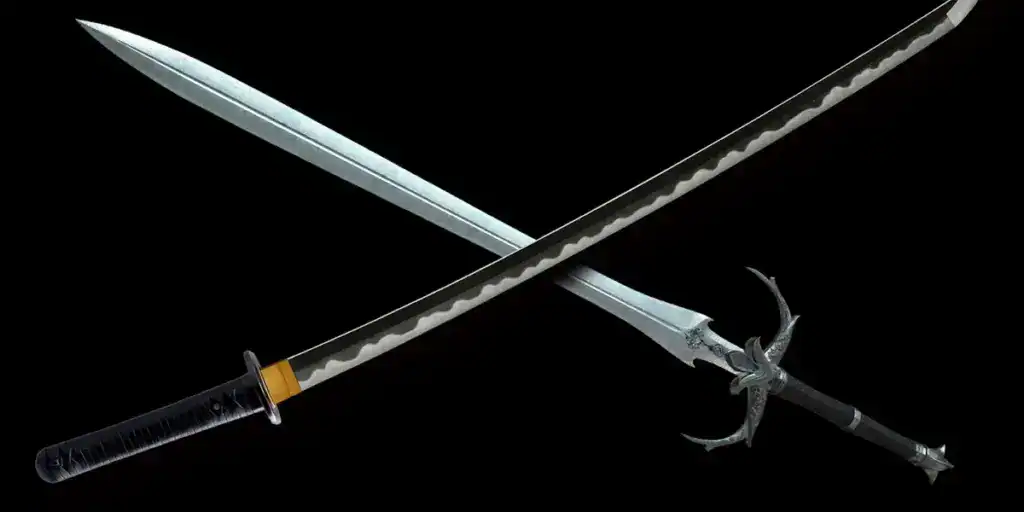
In a one-on-one duel between skilled fighters, the outcome depends far more on the individual than on the sword. Both weapons have proven lethal across centuries of real combat.
| Scenario | Katana | Longsword |
| Unarmored Duel | Strong: fast draw-cuts and close-range lethality | Slight edge: superior reach controls distance |
| Armored Battlefield | Weak: slicing edge ineffective against plate | Strong: thrusting, half-swording, pommel strikes |
| Quick-Draw Ambush | Wins: Iaido draw-strike is a unique advantage | Loses: straight blade and crossguard make fast draws slower and less practical |
In an Unarmored Duel
The katana’s cutting-oriented fencing makes it especially dangerous in close quarters. A skilled practitioner can close distance, draw, and deliver a finishing cut in a single continuous motion. Against an unarmored opponent, that speed is a real tactical asset.
The longsword answers with reach. A longsword fighter can control the distance of the duel, landing thrusts while staying outside the katana’s most effective cutting distance.
The double edge also removes the need to rotate the blade between strikes, allowing follow-up attacks from any angle without a wasted beat. HEMA (Historical European Martial Arts) practitioners frequently cite this as one of the longsword’s underrated advantages in the katana vs longsword matchup.
On an Armored Battlefield
The katana’s slicing edge becomes a liability against European plate armor. Drawing the blade across hardened steel does minimal damage and risks chipping the edge. A katana was designed for unarmored opponents wearing layered cloth and leather, not full plate.
The longsword was built with armored combat in mind. Techniques like half-swording (gripping the blade with a gloved hand to use it as a short lever) allow fighters to thrust into gaps at the neck, armpit, or visor. The pommel and crossguard also function as close-range bludgeoning tools when the distance is too short for a full swing.
In a Quick-Draw Ambush
Iaido (the Japanese art of drawing and striking in one motion) is the katana’s greatest tactical advantage in a surprise encounter. A practiced Iaido draw can land a fatal cut before an opponent has time to react. The technique was developed specifically for situations where the fight begins at close range with no warning.
The longsword has no equivalent response. Its straight blade and wide crossguard make a fast draw from a scabbard far slower and less practical than with a katana. In a sudden ambush at arm’s length, the longsword user is at a structural disadvantage regardless of skill level.
Katana Training vs Longsword Training
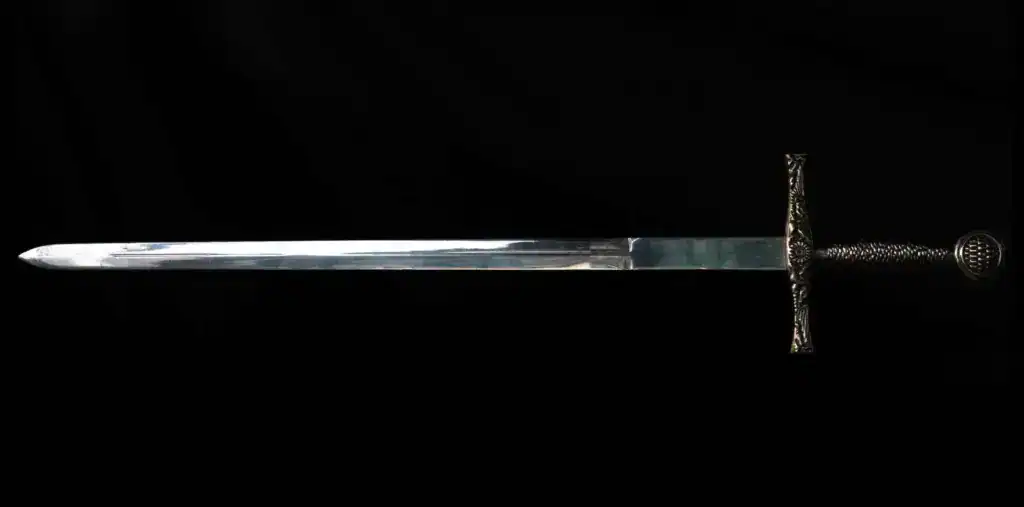
Japanese Kenjutsu and Iaido place strong emphasis on disciplined repetition and controlled movement. Forms (kata) are repeated thousands of times until the movement becomes instinct. The training has a ritualistic quality that appeals to practitioners drawn to discipline and tradition as much as combat skill.
HEMA takes a different approach. Longsword training in traditions like Liechtenauer’s German school involves wrestling, disarms, and half-swording techniques alongside standard blade work. It is grappling-heavy and pragmatic, built around the possibility that a fight may close to grappling distance.
Pick the tradition that matches what you want out of training, not just the cooler-looking weapon. If you are still deciding, our guide on choosing a katana for practice or display covers what to look for at each experience level.
If you lean toward katana training and want to practice tameshigiri (test cutting on rolled targets), the steel grade matters. Steels below 1060 carbon steel tend to lose edge retention more quickly during repeated cutting practice. Entry-level practice katanas in 1060 or 1095 steel typically run $150–$350, while entry-level HEMA longswords usually start somewhat higher due to their larger size and construction.
Browse our high carbon steel katana collection if edge retention and durability are your priorities.
Which Sword Looks Better in a Collection?
For display purposes, the katana has one visual feature the longsword simply cannot match: the hamon. On a well-made katana, the hamon is a wave-like pattern in the steel that reflects the differential hardening process. No two hamon look exactly alike, which gives each blade a distinct identity as an art object.
The longsword’s appeal is different. It carries the weight of medieval Europe: knights, castles, and the visual language of Western fantasy and history. For collectors interested in that tradition, a well-made longsword is a serious display piece with its own kind of presence.
The katana dominates the modern pop-culture collector market in a way the longsword simply does not. Characters like Zoro, Tanjiro, and Sasuke all wield katana-style blades, and that visibility drives demand for functional replicas among anime and gaming fans.
If that is the angle you are coming from, our anime katana collection includes replicas designed around specific series and characters.
Katana vs Longsword: Which One Should You Pick?
Neither sword is objectively better. Each one performs best in the scenarios it was designed for, and each represents a high point in its own military tradition. The katana excels in speed, precision, and draw techniques, while the longsword holds advantages in reach, armored combat, and overall versatility.
If you are drawn to Japanese history, the Samurai aesthetic, or meditative solo practice, the katana is the natural choice. If European medieval history, HEMA sparring, or the mechanics of armored warfare interest you more, the longsword makes sense. For collectors weighing both, display appeal and cultural resonance will matter more than tactical specs.
If you are buying as a gift and unsure about the recipient’s specific interests, the katana vs longsword choice usually comes down to aesthetics. The katana’s strong pop-culture presence often makes it the safer default for many recipients.
Browse our full katana collection to find the right blade for your skill level, training goals, or display setup.


