

Do Ninjas Use Katanas?

Do ninjas use katanas? Sometimes, but not as a universal ninja weapon. Historical shinobi may have used ordinary Japanese swords, including katana-like blades, when their status, disguise, or mission made that practical.
But there is no strong evidence for one standardized “ninja-only” sword, and the familiar straight ninjatō is better understood as a modern image than settled historical fact.
For a historical answer, context matters more than the label. Shinobi carried out missions, so their equipment could change with the job. The useful question is whether a particular role made a sword practical.
How strong is the evidence?
Period material tells us more about shinobi work than about a standard equipment list. Historical accounts and ninjutsu material connect shinobi with espionage, scouting, infiltration, sabotage, information-gathering, disguise, and escape. The record describes a role, not a separate, uniform military class.
An ordinary Japanese sword, including a katana-like or shorter blade, could fit a particular role, social position, disguise, or mission. The record does not identify one fixed sword type for every shinobi.
A practical possibility is not the same as a historical standard. Treat a katana-like sword as possible in context, not as proof that every shinobi carried one.
- Manual context: Read Bansenshukai and Shoninki for period ninjutsu themes. They do not establish a modern screen design as standard issue.
- Academic and museum context: work associated with Yuji Yamada, Mie University, and the Iga-ryu Ninja Museum helps frame shinobi historically. No single exhibit establishes a universal rule.
- Accessible explainers: Nippon.com and Japan House LA offer useful introductions, not substitutes for primary material or academic research.
- Modern interpretation: treat writers such as Antony Cummins and Stephen Turnbull as secondary interpretation, not equivalent proof.
Use that hierarchy when a sword listing makes a historical claim. A category name or modern silhouette describes a design, not historical proof.
Why an ordinary sword made sense
“Ninja” is a loose modern label. Shinobi work could overlap with the work of retainers, scouts, local fighters, and hired agents, though the exact relationship varied by setting. A single uniform outfit or weapon is a poor historical test.
An ordinary sword did not announce a covert role. A distinctive “ninja-only” blade might be memorable on screen, but it could work against disguise by making its carrier immediately recognizable. Availability also mattered.
Bansenshukai and Shoninki emphasize deception, intelligence, practical methods, and survival. They do not settle every question about historical loadouts, but they do not prescribe one official ninja sword either.
What sword did ninjas use?
There was probably no single “ninja sword.” Depending on era, status, disguise, and mission, a shinobi might have used an ordinary Japanese sword, a shorter sidearm, or no sword at all. That is messier than the film image, but it reflects a role shaped by context.
Katana-like and period swords
Curved period swords, including katana-like blades, tachi, or uchigatana, were plausible where a military or status-appropriate appearance called for them. Ask whether a blade fits that person’s time, role, disguise, and availability instead of assigning one sword to every shinobi.
Shorter sidearms
Shorter blades also fit some historical situations because they were easier to carry, conceal, or manage in confined spaces. A wakizashi could serve as a shorter sidearm, while a tanto could function as a compact backup or utility blade. Neither point proves that either was the standard ninja choice.
The straight ninja sword myth
The familiar image is a short, straight, often black sword with a simple or square guard. It is commonly called a ninjatō, ninjato, shinobigatana, or simply a ninja sword. Earlier sources do not clearly verify it as a standardized shinobi weapon.
Straight blades existed in Japanese sword history, but that is a different claim from saying shinobi had a standard ninja sword. A blade shape can exist historically without proving a ninja-issued weapon tradition. The period manuals discussed here do not establish a standardized straight ninja sword.
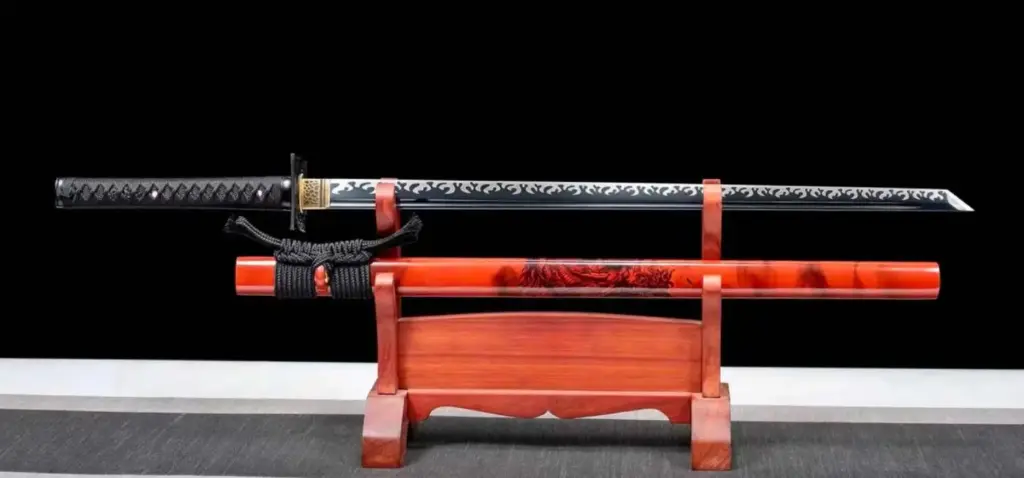
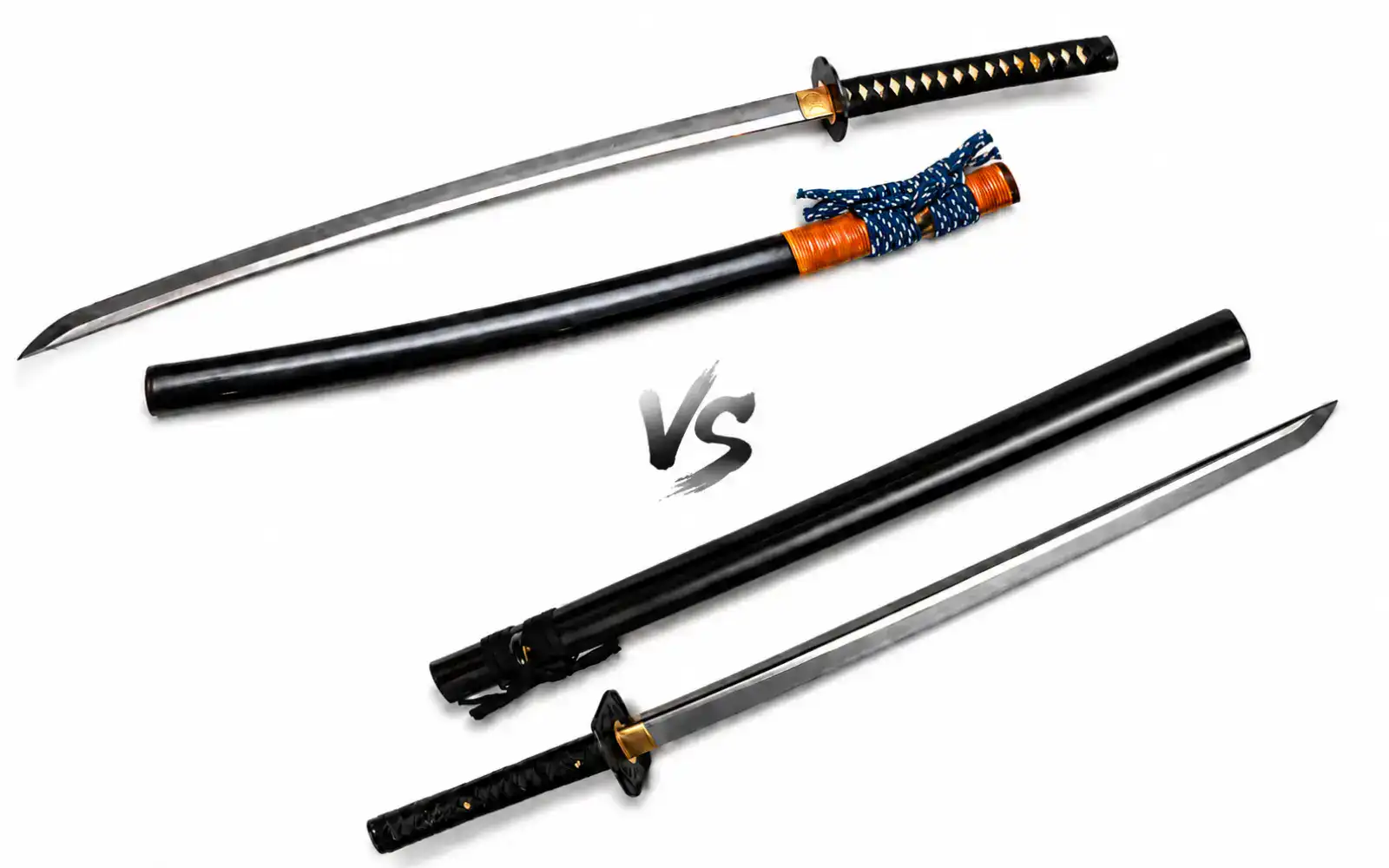
For collectors, that difference is practical. A modern ninjatō may be a media-inspired collector piece without documenting a historical loadout. Use our katana vs ninjato guide to compare modern design choices.
What ninjas used besides swords
Shinobi work could depend as much on access, movement, and escape as on a blade. That makes a mission-based picture more useful than a fixed weapon list.
- Blending in: Ordinary items and everyday tools could help a person avoid drawing attention.
- Movement and entry: Ropes, hooks, and climbing-related tools appear in the broader historical picture.
- Distraction and escape: Smoke or fire tools, thrown objects, and caltrops belong to historical equipment categories.
- Combat if necessary: A small blade, spear, bow, shuriken, or sword might be carried when a mission could turn violent.
Why movies and games made the ninja sword distinct
A straight black sword makes a clean visual contrast with the curved sword readers associate with samurai. On screen, that silhouette communicates “ninja” in a second, even when the underlying history is messier. Filmmakers and illustrators can use a shortcut that archives and manuals do not provide.

The same silhouette is easy to reproduce in toys, games, cosplay, posters, and product art. One weapon also compresses a complicated historical role into an instantly recognizable character type. Later fiction, martial-arts publishing, film, television, games, anime, and collector culture helped popularize the straight black ninjatō as a modern visual shorthand.
What a “ninja sword” means today
For history, picture a shinobi using ordinary or mission-appropriate Japanese weapons. The straight black ninjatō belongs to the modern cultural image.
When a listing makes a historical claim, look for source context. When it presents a modern design, judge it as a design instead.
- For a curved katana-style design, browse our Japanese katana collection.
- Collectors drawn to the straight black silhouette can browse modern ninjato interpretations.
- Pop-culture collectors can explore anime and movie katana designs.
FAQ
Did historical ninjas really carry katanas?
A katana-like sword is plausible in some shinobi contexts, but that does not make a modern “ninja katana” a documented replica. Treat “ninja” in a product label as a style cue unless the listing gives source-based historical context.
Is the straight ninja sword historically accurate?
No strong evidence supports it as a universal standard. A straight silhouette may describe a modern ninjato interpretation or a different historical blade form, but neither claim alone documents a shinobi weapon tradition. Check whether a listing separates design language from historical attribution.
Were ninja and samurai completely separate?
Not always. Role overlap means a samurai-associated sword shape does not rule out shinobi use in every context, but it does not prove it either. Treat the person, period, disguise, and mission as the historical questions, not the silhouette alone.
Sources and further reading
Start with Bansenshukai and Shoninki for period manual context. Research associated with Yuji Yamada and Mie University, along with the Iga-ryu Ninja Museum, helps frame shinobi historically.
Nippon.com and Japan House LA offer accessible explainers. Read Antony Cummins and Stephen Turnbull as modern secondary interpretations, not evidence equivalent to manuals or academic work.
Before choosing a sword, decide whether your reference point is a historical form or a modern cultural symbol. Then read the listing for source-backed history rather than treating its category name or silhouette as proof.


