



Real Hamon vs Fake Hamon: What the Photos Won’t Show You

Quick Answer
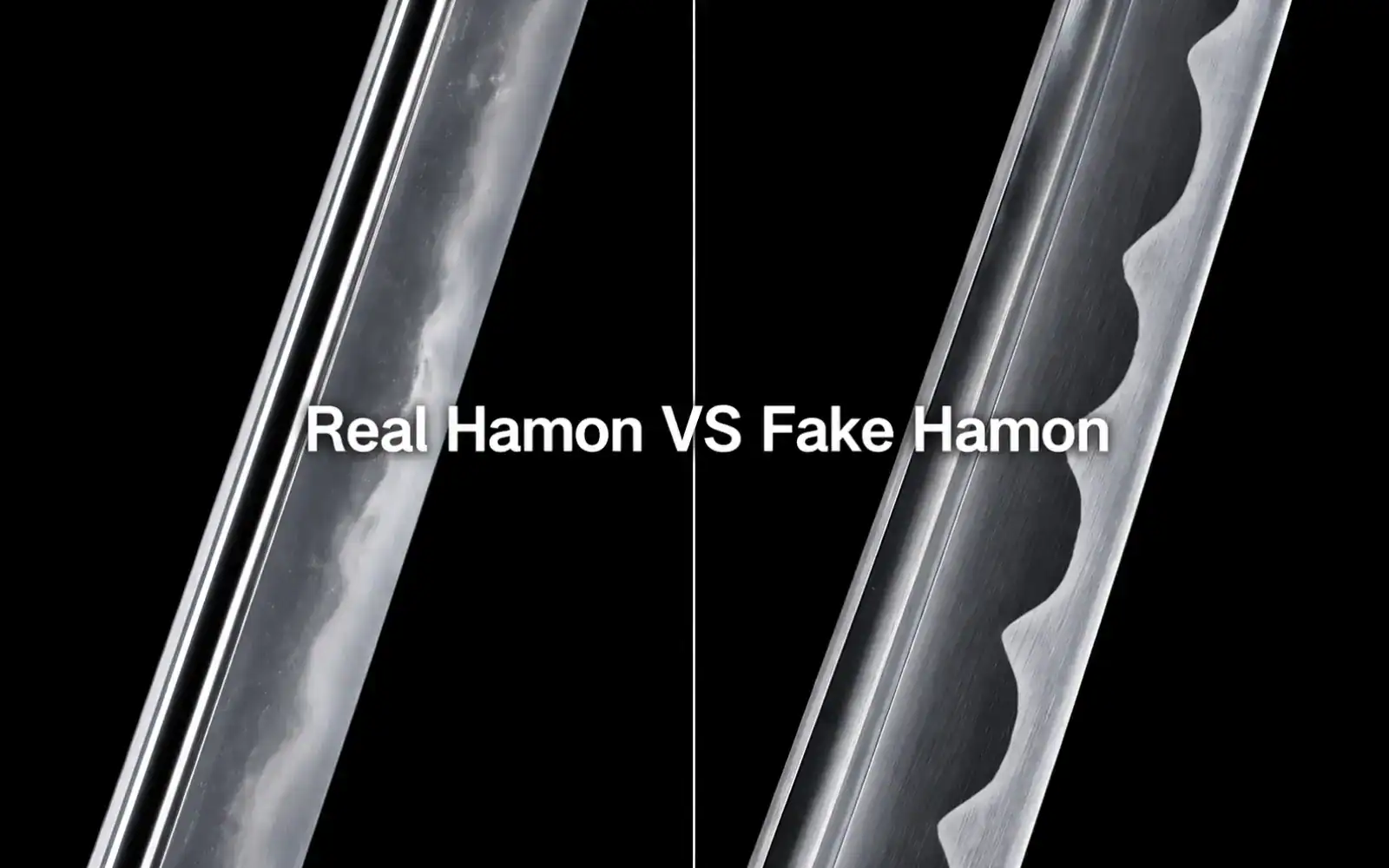
- A real hamon is a structural temper line created by differential hardening; it looks embedded in the steel and shifts in character as the blade moves under light.
- A fake hamon is a surface effect added after forging through acid etching, wire brushing, or sandblasting; it stays equally visible from most angles.
- Do not pay extra for a hamon claim unless the visual behavior and the seller’s explanation of the hardening process both support it.
Real hamon vs fake hamon is what stalls most buyers mid-listing. The seller says clay-tempered. The studio photo shows a dramatic wave. You cannot tell from a single angle whether you are looking at a genuine temper line or a wire-brushed finish that cost the maker nothing extra.
The proof is usually simpler to get than the listing makes it look. Whether a cosmetic hamon is actually a problem depends on why you are buying: a display sword, a gift, and a training blade each have a different answer.
Real Hamon vs Fake Hamon: Quick Check
Before the full breakdown, this table shows the fastest signals any buyer can check from photos, video, or an in-hand inspection. Any signal pointing toward fake is reason enough to ask more questions before paying extra.
| Signal | Real hamon | Fake hamon |
| Light response | Changes, softens, or brightens as the blade moves | Stays equally visible from all angles |
| Boundary look | Organic, slightly misty, less graphic | Sharp, flat, or drawn-on looking |
| Pattern rhythm | Small natural irregularities | Repeated or stencil-like spacing |
| Surface texture | Looks embedded in the steel | May show scratch, brushed, or printed-on texture |
| Seller proof | Explains steel, hardening method, and finish | Relies on vague phrases and avoids specifics |
The Short Version
Most buyers are not trying to become metallurgists. They are trying to judge one listing before they buy. The clearest rule: do not pay extra for a real hamon claim unless both the visual behavior under light and the seller’s process explanation support it.
A cosmetic hamon is not automatically a bad thing. For display buyers, gift purchases, cosplay pieces, and replica collecting, the look is the point. The problem starts only when a seller prices it as a functional premium without delivering one.
A quick baseline on what differential hardening should actually mean in a listing: what is a hamon on a katana covers the fundamentals.
Is Real Hamon Worth the Extra Cost?
There are three cases. Pay extra when the visual behavior changes under a single moving light source, the seller explains the steel and hardening method clearly, and the sword will see actual functional use.
Cosmetic is fine when the listing describes the finish honestly and the price reflects appearance, not heat treatment performance. A listing that says “acid-etched hamon” or “cosmetic finish” at a price that fits is being transparent. That is not a problem.
Hold off on paying more when the line looks dramatic but the seller’s explanation is vague, incomplete, or avoided entirely.
What Photos Can and Can’t Tell You
Photos are a useful first screen but they do not prove the claim on their own.

What you can spot from photos
Photos are good for catching obvious red flags: repeated or stencil-like patterns, flat contrast that looks identical across the whole blade, and a line that appears equally visible from every angle shown. A listing that provides only one polished studio image, with no angled-light shots, tip photos, or video, is already telling you something.
The absence of multi-angle media is itself a signal. A seller confident in a real hamon should be able to show it from more than one position.
What sellers should explain
Strong proof connects the visible hamon to the steel type, the hardening method, and the finishing process. A seller claiming clay tempering should be able to explain the steel, the differential hardening method used, and how the finish makes the hamon visible.
Plain, specific answers are worth more than dramatic marketing language. A seller who says “1095 high carbon, clay-coated spine, water quench, hand-polished finish” has explained the process. A seller who says “authentic samurai hamon, traditional craftsmanship” has described a feeling, not a process.
Why cheaper swords use cosmetic lines
True differential hardening takes more labor, more time, and carries real production risk. A blade can crack or warp during the quench, and the maker absorbs that cost. That is why the process is priced into every honestly-listed clay-tempered sword.
Wire brushing and acid etching require far less skill and cost far less by comparison. Cosmetic hamon is common at the budget end of the market not because all sellers are deceptive, but because it keeps costs down while giving buyers the visual they want.
The problem starts when the listing does not say so. See how a trustworthy functional listing should describe a clay-tempered blade: katana for sale gives a live mid-range benchmark.
What Real vs Fake Hamon Look Like
Most buyers focus on brightness. The more reliable test is how the line behaves as the blade moves.
What a real hamon usually looks like
A real hamon often changes as the blade moves. Under a single point of light, some areas brighten while others soften. The line can seem to partially fade at certain angles and reappear when the blade shifts. That angle-dependent behavior is the most reliable first indicator.
The line itself looks like part of the steel rather than something sitting on top of it. The boundary between the harder edge and the softer spine tends to be organic and slightly misty, not sharp and graphic.

What a fake hamon usually looks like
Cosmetic lines tend to stay equally visible from most angles. There is no brightness shift, no fading, no softening depending on how the light hits. A fake hamon that looks loud in one photo usually looks about the same in another.
The contrast also behaves differently. Sharp, high-contrast lines that look drawn on rather than emerging from the steel are a common marker. Patterns that repeat at regular intervals across the blade are another.

Common ways fake hamon is made
Four finishes show up most often on swords with cosmetic hamon. Each has a visible tell:
- Acid-etched: White, cloudy, and convincing at first glance. Stays equally visible at any angle. A cosmetic etched line may fade with polishing, while a structural hamon is not merely a surface coating.
- Wire-brushed: Fine scratch marks run across the surface in the hamon zone. The pattern repeats at stencil-like intervals and can be felt as texture on the steel.
- Sandblasted or abrasive-finished: The matte, surface-worked area looks dull against the polished spine. The difference is abrasion, not crystalline structure.
- Printed or heavily applied: The sharpest, most graphic contrast with the most regular spacing. Reads as decorative because the pattern has no relationship to how the steel was hardened.
Faint doesn’t mean fake
A subtle or hard-to-see hamon is not automatically cosmetic. Visibility depends on the steel type, the finishing method, and how the blade was polished. Some genuinely clay-tempered blades show a quiet line that only appears under direct focused light.
The boldest-looking hamon is not always the most honest. An acid-etched line can be visually louder than a genuine one. Judge by behavior and process proof, not brightness alone.
What’s happening under the polish
You do not need these terms to buy a sword, but they help explain why real hamon can look different from fake ones. Nioi refers to the misty, cloud-like boundary effect along the temper line. Nie refers to brighter, more distinct crystalline activity visible as small bright specks at or near the boundary.
Cosmetic finishes may imitate the look, but they do not create the same underlying crystalline activity.
Polish style also affects what you see. Hadori and sashikomi can make the same underlying hamon appear different, so visibility alone is not proof of real or fake.
What to Ask Before You Buy
These four questions work as a trust filter. Send them before paying any premium.
| Question | Good answer | Weak answer | What to do |
| Is it differentially hardened or through-hardened? | Gives a direct answer that matches the listing | Avoids the process and repeats marketing language | Do not pay extra; try a different seller |
| Can I see fresh angled-light photos or a short video of the actual blade? | Sends proof of the actual sword | Refuses or relies on stock listing photos | Claim is unverified; do not pay the premium |
| What steel is it, and what does the hamon claim mean on this blade? | Connects steel, hardening method, and appearance clearly | Uses broad terms without specifics | Discount the hamon premium |
| Is the hamon natural only, or made more visible during finishing? | Distinguishes structural hamon from finish enhancement | Repeats that it is “real” without clarifying how | Do not pay the premium |
Good answers vs. evasion
Favor specific, technical replies over dramatic marketing language. “1075 high carbon, clay-coated spine, water quench, hand-polished finish” tells you something. “Real authentic hamon, traditional craftsmanship, just like samurai used” tells you nothing about the process.
Treat evasive answers as a buying signal, not a communication gap. A seller who cannot explain their own hamon claim may not have the information, which is the answer.
Move forward or walk away
Proceed when the seller sends fresh, angled-light photos or video of the actual blade and gives a process answer that fits the listing and price.
Downgrade the claim when answers are incomplete or the only proof is stock listing images.
Walk away from premium-priced listings that cannot explain the hamon claim after being directly asked.
What Price Usually Tells You
Budget listings often have cosmetic hamon with no process explanation, which is fine for appearance-led buying but not for premium heat-treatment claims. Mid-range is a mixed market; the same seller questions still apply before paying more. At premium and custom tiers, expect both visual and technical proof. A higher price should mean better proof, not a louder-looking line.
Already Have It? Check at Home
These checks can improve your confidence but they do not replace seller proof or expert appraisal. Treat them as a starting point, not a verdict.
Check it under one light
Move the blade slowly under one focused light source and watch the hamon zone. A line with some structural basis will shift in character as the angle changes. It may soften, brighten, or partially fade. It will not behave the same way from every angle.
Watch the boundary between the line and the spine, not just the line itself. Depth and variation matter more than brightness.

Look for surface-only signs
Tilt the blade under a low raking light and check for scratch-like texture in the hamon zone. A wire-brushed hamon shows fine directional marks visible as surface scratches, not embedded structure. Also check for contrast that looks identical no matter which angle you try.
If you decide yours is cosmetic
What it means depends on why you bought the sword. A display sword with a cosmetic hamon that was sold as display is exactly what it should be. A sword bought as a functional piece with a premium paid on the hamon claim is a different situation.
A cosmetic hamon does not make the sword useless for the purpose it was honestly sold for. It only matters if the listing’s hamon claim was the reason for paying more.
When Cosmetic Hamon Works
Cosmetic does not automatically mean bad. The question is whether the listing is honest about what it is.
Good fit for display and replica buyers
Display buyers, gift buyers, cosplay collectors, and anime-replica buyers are not paying for functional performance. They are paying for the look. A cosmetic hamon is a rational choice for this group when the listing says what it is and prices it accordingly.
For a gift, an honest cosmetic hamon is usually the right call unless the recipient specifically cares about functional heat treatment.
A seller who honestly prices a display sword with a polished cosmetic line is giving this buyer what they need. How to choose a katana for practice or display breaks down the full decision between appearance-first and performance-first buying. Replica and anime-style display buyers have a dedicated category: anime and movie katana.
Good fit for budget-first buyers
Budget buyers who mainly want the look are not making a mistake. The smart move is paying for honesty and fit, not chasing the loudest-looking hamon in a listing. A seller who clearly marks a wire-brushed or acid-etched line as cosmetic is a more honest partner than one who implies clay tempering without delivering it.
When Paying More Makes Sense
Shop by honest heat-treatment disclosure first, then by use case, then by hamon appearance last.
Best fit for functional buyers
Buyers who care about a real hamon are usually paying for transparent heat treatment, not a brighter line. A blade that was genuinely differentially hardened is one where the maker controlled the edge hardness and spine toughness separately. That matters if you plan to use the sword, train with it, or want to know exactly what you paid for.
For collectors, real hamon matters more when it is tied to documented process, polish quality, and the actual blade shown, not just a product-page claim. Start with steel and hardening disclosure.
Best steel for katana explains what the steel type should tell you before you even ask about hamon. From there, browse katana for sale and filter by listings that explain the process, not just the look.
Best fit for custom and high-ticket buyers
At the custom tier, “real hamon” should become a specification, not a promise. Before paying for a commission, confirm the steel, the hardening method, the finish type, and what proof you will receive of the actual blade. Vague hamon claims at the high-ticket level are a red flag, not a feature.
Custom katana is where to start when building specifications for a commissioned piece.
Common Mistakes Buyers Make
A real hamon does not automatically justify a higher price for the whole sword. Studio photos often show the best example from a production run, not the blade you will actually receive. Always ask for fresh, actual-blade media when the hamon is part of the premium.
Broader sword authenticity is a separate question from hamon verification. A real hamon tells you about heat treatment, not forging quality, steel sourcing, or fitting workmanship. Mistakes to avoid when buying a katana covers the wider picture.
FAQ
Direct answers to the questions buyers ask most before making a decision.
How can you tell if a hamon is real?
Move the blade under one light source and watch whether the line shifts in character. Organic variation at the boundary and a clear seller explanation of the hardening method are the other two signals. A line that stays equally visible from every angle is more likely cosmetic.
Does a real katana always have a hamon?
No. Visible hamon depends on the hardening method, the finish, and the blade style. Through-hardened blades have no temper line because the steel is hardened uniformly. Some differentially hardened blades show only a subtle line depending on polish. A katana without a visible hamon is not automatically a fake sword.
Why doesn’t my katana have a visible hamon?
Through hardening, a polish style that does not emphasize the line, or a naturally subtle result on this steel are all common reasons. Not every blade is finished to highlight the temper line. Check under direct focused light before concluding there is nothing there.
Is a wire-brushed hamon fake?
Yes, in the practical buying sense. Wire brushing is a cosmetic surface treatment, not evidence of differential hardening. It tells you the blade looks like it has a hamon. It does not tell you the edge and spine were hardened separately.
Is a fake hamon bad?
Not automatically. A fake hamon is a problem only when a seller prices it as real differential hardening. Display buyers, gift buyers, and budget buyers can get exactly what they need from a cosmetic hamon when the listing is honest about what it is.
Can stainless steel have a real hamon?
Some stainless alloys can be differentially hardened, but the result is rarely what online sword listings describe as clay-tempered hamon. Many stainless steel swords, especially at budget and mid-range price points, are through-hardened or cosmetically finished. Treat any stainless hamon claim with extra skepticism and ask about the specific alloy.
What if the seller won’t send new photos or video?
Treat the hamon claim as unverified and do not pay extra for it. A seller who cannot show the actual blade in fresh angled-light conditions is not proving the claim. The hamon premium is worth paying only when the proof is there.
Final Takeaway
The decision rule is simple: pay for a real hamon only when the seller can explain the hardening process clearly and the blade’s visual behavior under light supports the claim.
A cosmetic hamon is the right call when the use case is visual, the listing is honest, and the buyer is not paying for metallurgical performance. That covers most display buyers, most gift buyers, and most budget-first buyers.
Functional buyers should shop by heat-treatment disclosure and use-case fit first, then check hamon appearance last. Custom buyers should turn the hamon request into a build specification before any money changes hands.


