




Are Katanas Legal? What You Can and Can’t Do as an Owner

Katanas are legal to own in most countries — but “legal to own” and “legal to carry” are two very different things. Private ownership is broadly permitted across the US, Canada, Germany, and much of the world.
The restrictions kick in the moment a blade leaves the front door: public carry laws, transport rules, age requirements, and import classifications create a patchwork of obligations that varies by country, state, and city. What’s allowed in one jurisdiction can be a misdemeanor or worse two hours down the road.
Quick Answers for Most Buyers
- Keeping a katana at home is legal for adults in most US states and many countries, but local restrictions still matter
- Carrying one in public is heavily restricted nearly everywhere
- Ordering online and shipping domestically is generally straightforward in the US
- International shipping requires accurate customs declarations and country-specific research
- Air travel is allowed only in checked luggage, declared at the desk
- Local city rules can be stricter than national or state law — always check both
Can You Legally Own a Katana?
For most adults, yes. Katanas are typically classified as collectibles, antiques, or sporting equipment rather than regulated weapons, which keeps them outside the scope of federal firearms legislation in the US and equivalent national laws in Canada and Germany.
The compliance burden falls entirely on the owner. Federal or national permissiveness does not guarantee local legality — cities and municipalities frequently layer their own restrictions on top, including blade length limits, permit requirements, or outright prohibitions in dense urban areas. Before purchasing, confirm the municipal code for your home address, not just your state or country.
The table below covers ownership status across the regions most relevant to buyers.
| Country/Region | Ownership Status | Main Limitation |
| USA | Generally legal, 18+ | No federal ban; state and city rules vary |
| UK | Restricted | Curved swords over 50cm are restricted unless a legal defence applies |
| Canada | Generally legal | Treated similarly to knives; local rules still matter |
| Australia | Varies by state | Victoria uses an exemption/membership model; other states differ |
| Japan | Conditional | Traditional nihonto can be registered; modern reproductions follow different rules |
| Germany | Generally legal, 18+ | Ownership is usually allowed; public carry is more restricted |
Japan clarification: The common claim that swords “must be registered with police” is inaccurate. Key points for Japan:
- Traditional nihonto (日本刀 — classical swords forged by a government-licensed swordsmith) are registered with the prefectural Board of Education or the Agency for Cultural Affairs (文化庁), not the police
- Mass-produced reproductions and imported display swords are not eligible for nihonto registration as art swords
- Their legal status should not be assumed equivalent to properly registered traditional blades
Germany clarification: The legitimate-interest requirement in German weapons law (§42a WaffG) applies primarily to public carry, not to home ownership itself:
- Owning a katana at home as a collector or practitioner is generally lawful
- The obligation to demonstrate a legitimate purpose arises when taking the sword into public spaces
In 2025, the UK added restrictions targeting straight-bladed “zombie swords” — knives with serrated spines and pointed tips, sometimes marketed as ninja swords. Traditional curved katanas fall under existing defences, but qualification depends on several factors:
- How the sword is made (hand-forged traditional construction vs. mass-produced)
- How it is marketed and sold
- The intended use (antique collection, martial arts practice, etc.)
If you are in the UK and unsure whether a blade qualifies as a prohibited straight replica or a legal curved katana, the design differences are covered in the katana vs ninjato comparison.

Is It Legal to Carry a Katana in Public?
Private ownership and public carry operate under entirely different legal standards in almost every jurisdiction — and the gap between them is wider than most first-time collectors expect.
In the US, state laws diverge considerably:
- Texas permits open carry of swords in most public spaces with relatively few restrictions
- California heavily restricts carrying swords in public, and local ordinances in cities like Los Angeles can complicate even transport in a locked case
- New York treats concealed edged weapons as presumptively unlawful in public spaces
- Chicago and Washington D.C. have city-level rules that are more restrictive than their surrounding state laws — worth checking separately before any trip through either city
The UK and Canada apply a “lawful excuse” standard — having a blade outside the home is not automatically a criminal offense, but the owner must provide a verifiable reason for transport to a specific destination. What counts and what doesn’t:
- Qualifies: traveling to a certified martial arts class with dojo documentation
- Does not qualify: carrying the sword for general purposes or recreational outings
- Documentation helps establish context if questioned, but does not override a local restriction
Drawing a katana in any shared space — a park, a street, a parking lot — can quickly lead to charges such as brandishing, disorderly conduct, or public endangerment, even when no injury occurs.
The practical standard for any trip involving a katana is to treat it as a documented transfer: written confirmation of the destination, proof of legitimate purpose, and the sword secured and out of reach during transit. Collectors who move between training and display contexts can find guidance on choosing the right blade for each in the how to choose a katana for practice or display article.
Buying, Shipping, and Importing a Katana
In many jurisdictions, buyers must be 18 or older to purchase a functional sword. Reputable vendors enforce this through age verification at checkout and often require a signature on delivery. For parents or gift buyers: purchasing a functional sword on behalf of someone under 18 can create legal exposure for the buyer in some states — not just the recipient.
Within the US, interstate shipping of swords is generally unrestricted. International imports are a different matter. Customs agencies in Canada (CBSA), the UK (HMRC), and Australia (ABF) classify imported blades with increasing scrutiny. Two categories are consistently flagged for seizure regardless of declared value:
- Disguised weapons — cane swords, blade-concealing umbrellas, or anything designed to look like a non-weapon
- Misdeclared shipments — functional swords declared as decorative items to reduce customs classification risk
Declaring blades accurately and verifying the receiving country’s import rules before purchase is the only reliable way to avoid confiscation. The where to buy a functional katana guide covers what separates reputable international suppliers from those who routinely create border problems for buyers. Import and sourcing mistakes that catch new collectors off guard are addressed in the katana buying mistakes guide.
Can You Bring a Katana to a Convention?
Usually not, if it is metal. Most large conventions — anime, comic, and gaming events — enforce “no live steel” policies that apply to all metal blades, sharpened or unsharpened. A blunt iaito (居合刀 — an unsharpened aluminum alloy practice sword used in Japanese sword-drawing arts) gets turned away at the same checkpoint as a razor-sharp functional katana.
Events that do permit metal props typically require “peace-tying” — securing the blade to the saya (鞘, the scabbard) with a brightly colored zip tie to show security staff the weapon has been inspected and cannot be quickly drawn. Even with peace-tying in place, convention security staff retain discretion to deny entry.
The only approach that clears security reliably at any event is a high-quality replica in wood, foam, or hard plastic. These pass checkpoints without inspection and are increasingly hard to distinguish from real steel in photographs and videos.
How to Transport a Katana by Car or Plane
Car and air travel follow different rules, and both require preparation before the trip — not at the checkpoint.
Driving with a Katana

In many jurisdictions, the safest approach is to transport a katana in a locked, hard-shell case stored out of reach — ideally in the trunk. A sword in a soft bag on the back seat, or in an unlocked case, generally does not meet this standard. States like California apply the requirement strictly; having a legitimate destination does not substitute for proper storage during transit.
UK and European drivers face similar expectations: the blade should be cased and stored in a way that makes it clearly unavailable for immediate use, with a demonstrable lawful purpose for the journey.
Flying with a Katana
Before heading to the airport, here is what the rules actually require:
- Declare at the check-in desk, not at the security checkpoint — bringing a blade directly to the TSA lane triggers a very different process
- Checked luggage only, inside a hard-shell case; soft rolling luggage is not accepted under most carrier policies
- TSA explicitly permits swords in checked baggage with proper packaging; most international carriers follow similar rules, but confirm with your airline before travel
One point that catches travelers off guard: swords are not covered by the Firearm Owners Protection Act (FOPA), which allows legal firearms to transit through states where they would otherwise be prohibited. No equivalent protection exists for edged weapons — a layover in a city with restrictive sword ordinances can create legal exposure even when the origin and destination are both fully permissive.
Carrying physical documentation — a purchase receipt and a dojo membership card or event registration — gives law enforcement or airport security immediate context for the transport.
What About Self-Defense?
Using a katana in a self-defense situation carries significant legal risk that most owners underestimate. The proportionality principle in US and UK law requires that force used in self-defense be reasonably matched to the threat. A sword is a lethal weapon, and lethal force is generally only legally justified against an immediate lethal threat — not a perceived threat or a precautionary response.
Beyond proportionality, edged weapon injuries produce outcomes that complicate legal proceedings in ways that other self-defense scenarios typically do not. Cases involving swords frequently result in charges of aggravated assault or excessive force even when the underlying threat was real.
Keeping a katana in a private residence is legal in most jurisdictions. Using it defensively is a different category with a legal risk profile that is rarely straightforward. Treating the sword as a training tool or historical artifact is the position that most clearly separates a collector from a defendant.
Decorative vs. Functional: Which Is Easier to Own?
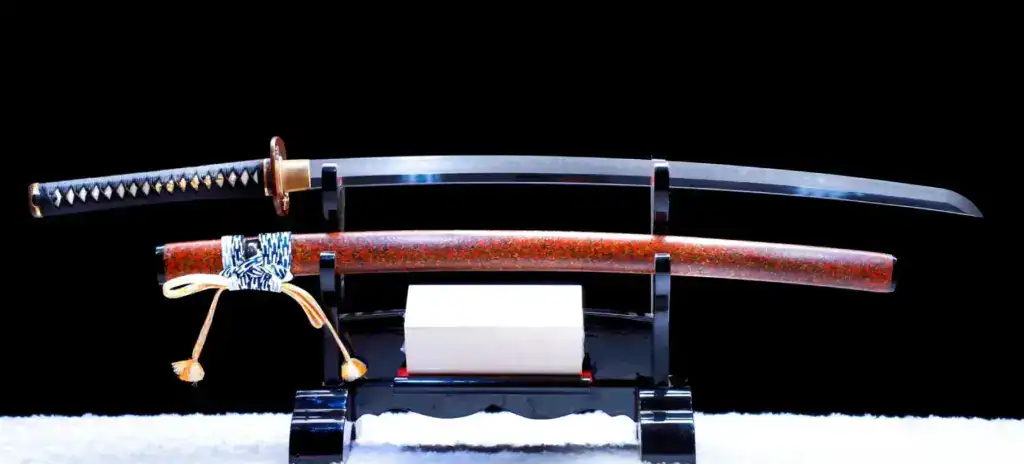
The regulatory gap between display models and sharp functional swords is larger than most new collectors expect. Unsharpened wall-mount pieces are treated as art or décor in most jurisdictions, drawing little attention from customs agencies or law enforcement. Quality display katanas typically start around $80–$200.
A functional katana with a geometry-correct edge — the kind used in tameshigiri (試し斬り, test cutting practice) or iaido (居合道, a Japanese martial art focused on drawing technique) — is treated as a weapon in many of the same jurisdictions, triggering permit requirements, carry restrictions, and import classifications that display blades avoid. Functional swords range from around $150 for entry-level high-carbon steel to $1,000 or more for hand-forged pieces.
Which Type Fits Your Situation?
- Home display, apartment, or heavily regulated city — a decorative or unsharpened blade avoids most of the legal friction associated with functional steel
- Dojo or iaido practice — a training-appropriate functional sword is necessary, but verify local transport rules before buying
- Test cutting (tameshigiri) — a functional katana is required; lawful storage and transport need to be realistic for your location first
- Convention or cosplay — a wood, foam, or hard plastic replica is the only option that reliably clears event security
- Gift for a younger collector — a decorative or unsharpened display piece avoids age-restriction and liability complications entirely
For collectors in more restrictive jurisdictions, display-oriented pieces in the anime & movie katana swords category offer a lower-barrier path to ownership without triggering the regulations that apply to functional sharp steel.
Stay Legal, Stay Safe
The rule that applies across every jurisdiction: owning a katana at home is not the same as carrying it in public. Private ownership is broadly permissible. The moment a blade moves into a shared space, the law’s tolerance narrows sharply.
Sword laws are not static. The UK updated its blade restrictions in 2025, and municipalities in the US regularly revise weapon ordinances without publicizing the changes. Confirming local rules at the point of purchase — and periodically after — is the only reliable way to stay current. Are katanas legal where you live? The answer may have changed since the last time you checked.
For collectors ready to make a compliant purchase:
- If your priority is training or cutting practice, browse our japanese katanas and filter by intended use
- If your priority is display, gifting, or convention-safe styling, browse the anime & movie katana collection instead
Frequently Asked Questions
Are katanas legal to own in the US?
Yes, for adults in most states. There is no federal ban on sword ownership. State and local rules vary, so confirming your municipality’s ordinances before buying is advisable.
Can you keep a katana in your car?
In many jurisdictions, the safest standard is a locked, hard-shell case stored out of reach during transport — typically in the trunk. Having a legitimate destination does not substitute for proper storage while the vehicle is moving.
Can you fly with a katana?
Yes, in checked luggage only. Declare the sword at the check-in desk, not at security. It must be in a hard-shell case. Carry-on is not permitted on any major airline.
Are dull katanas allowed at anime conventions?
Usually not, if they are metal. Most conventions ban all metal blades regardless of sharpness. Wood, foam, or hard plastic replicas are the only reliable option for conventions.
Is it legal to use a katana for self-defense?
Legally complicated in almost every jurisdiction. Lethal force from a sword is generally only justifiable against an immediate lethal threat, and edged weapon cases frequently result in serious charges even when the defender had legitimate reason to act.
Are decorative katanas easier to own than functional ones?
Yes, in most places. Display and unsharpened blades are typically treated as décor rather than weapons, which avoids permit requirements, carry restrictions, and stricter import classifications that apply to sharp functional swords.


