


T10 vs 1095 Katana Steel: Hold an Edge or Sharpen Easier?

T10 vs 1095 steel for katana sounds like a major divide on product pages, but in real ownership the gap is usually modest. Buyers comparing a cutter, a display sword, or a clay-tempered blade with visible hamon often get pushed toward one label as though it settles the purchase. Usually it does not. Heat treatment, geometry, finish, and overall build quality matter more.
This guide is for readers already choosing between these two steels and wanting a clearer decision based on use, maintenance, visual character, and value.
The Short Answer: Which Steel Should You Choose?
Most buyers do not need to treat this as a winner-takes-all steel fight. The better question is which blade fits how you plan to use it.
Quick answer: T10 usually suits buyers who want a cutter-first build and do more cutting than display. 1095 usually suits buyers who care more about hamon, traditional feel, and easier touch-up sharpening. In either case, build quality should decide the purchase.
T10 vs 1095 Katana Steel Comparison Table
For most buyers, the real differences come down to edge feel, sharpening, hamon style, and whether paying more is justified.
| Decision point | T10 | 1095 |
| Edge feel | Often sold as the more performance-leaning option. | Usually close in practice, but less often sold on edge-life claims. |
| Sharpening and upkeep | Can feel a little less forgiving when you touch up the edge yourself. | Often feels a bit easier to refresh on stones. |
| Bad-cut tolerance | Can be a strong workhorse choice when heat treatment and geometry are done well. | Still reliable in a good build, but not mistake-proof. |
| Hamon look | Often appeals to buyers who like a cleaner temper-line look. | Often appeals to buyers who want a bolder traditional contrast. |
| Best for | Buyers who want a cutter-first feel and do not mind paying more when the whole build earns it. | Buyers who want traditional character, easier upkeep, and a strong value case. |
T10 vs 1095: What Is Actually Different?
T10 and 1095 are different, but not in the dramatic way many listings imply. Both are high-carbon steels, both can support a hard edge, and both appear often in clay-tempered katana builds. Buyers new to T10 usually see it presented as a higher-end production option, which is why it gets compared so directly with 1095. The bigger separator is how well the maker handled heat treatment, grinding, polish, and final assembly.
What They Share
For most collectors and practitioners, the overlap matters more than the difference.
- Both steels are capable of taking a hard, useful edge.
- Both are commonly used in differentially hardened or clay-tempered blades.
- Both need regular care because neither should be treated like a low-maintenance stainless sword.
Leave either blade dirty or damp after cutting and rust becomes a more immediate problem than any small steel advantage.
Why the “Tungsten Advantage” Needs Caution
T10 is often sold with a stronger metallurgy story, sometimes framed around tungsten or other upgrade language. Buyers should treat that pitch cautiously because sellers do not always use the term with much precision, and it can make the gap sound larger than it feels in real ownership. A better-forged, better-treated 1095 blade is still the smarter buy than a weaker T10 sword with a louder product description.
Experienced buyers treat the steel label as one filter, not the final answer. In much of the English-language katana market, execution matters more than metallurgy copy.
T10 vs 1095 in Real Use
In real use, this comparison comes down to three things: edge life, sharpening effort, and how the sword handles imperfect cuts.

Edge Retention vs Sharpening
T10 is often described as holding a working edge a little longer, while 1095 usually feels a little easier to bring back when the edge needs attention. The tradeoff is real, but still modest. Light cutting, occasional tatami sessions, or mostly display ownership may not reveal much difference at all.
The gap matters more when a buyer plans to use the sword regularly and maintain it personally. In that setting, 1095 can appeal to owners who want a simpler touch-up routine on stones, and how to sharpen a katana is the next useful step if maintenance is part of your buying decision.
Toughness, Chipping, and Bad Cuts
Neither steel is indestructible, and neither one should be bought with the idea that it will forgive careless targets or poor cutting mechanics. A bad cut into a hard stand, a twisted bottle cut, or an off-angle strike on backyard targets can chip, bend, or otherwise punish either blade.
Heat treatment quality matters more than forum mythology here. A sword with smarter geometry and cleaner hardening will usually come through a slightly messy cut better than a poorly made blade wearing a more impressive steel name.
T10 vs 1095 Hamon: Which Looks Better on a Clay-Tempered Katana?
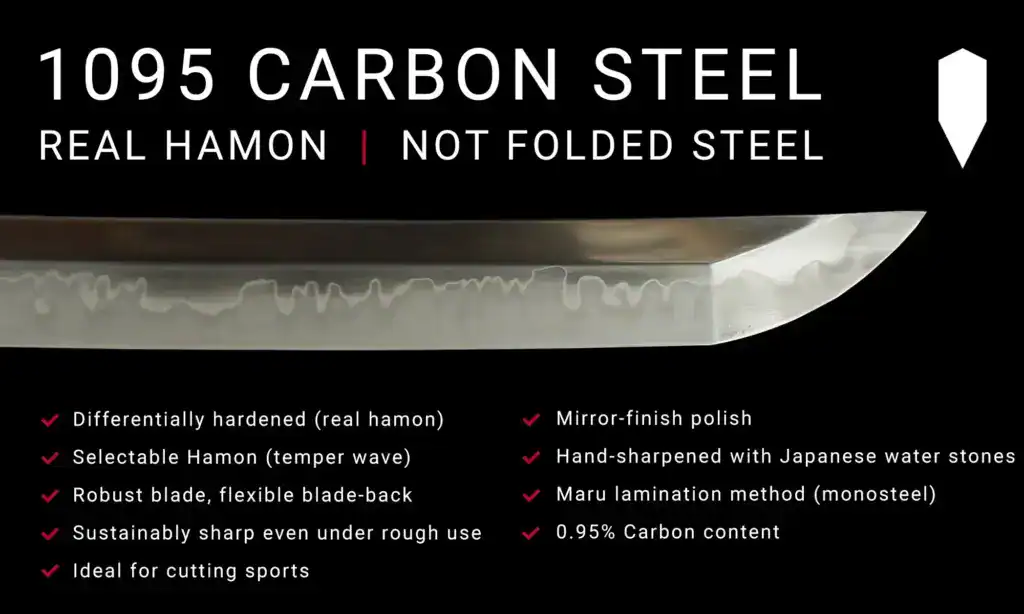
For visual impact, many buyers prefer 1095 when they want a wider, bolder, more traditional-looking hamon, meaning the visible temper line created by differential hardening. Others like T10 because the line can read cleaner and finer. Neither preference proves that the sword is better made.
If hamon appearance is a big part of why you are shopping in this category, What Is a Hamon on a Katana? gives the background without turning a style preference into a fake technical rule.
Who Should Buy T10 or 1095?
This decision gets easier when you match the sword to the buyer instead of forcing a universal winner.
Choose T10 If…
Choose T10 when you plan to cut more than you display and want a cutter-first feel, provided the full build supports that promise.
- You want a workhorse feel more than a specifically traditional look.
- You expect to use the sword enough that a small edge-holding advantage could matter.
- You are evaluating the whole build and not paying extra for the steel name alone.
Shop T10 Carbon Steel Japanese Sword listings to compare builds, not just steel names.
Choose 1095 If…
Choose 1095 when traditional character, strong hamon appeal, and easier routine upkeep matter more than chasing a small cutting edge on paper. That does not make it the lesser choice. It serves a different buyer profile.
- You care about the classic look of a clay-tempered katana as much as its cutting role.
- You would rather have easier edge upkeep than chase a modest theoretical advantage.
- You want a sword that feels rooted in traditional presentation without overspending on marketing.
Compare 1095 Carbon Steel Japanese Sword options if hamon character and easier upkeep matter more.
If You’re Still Torn, Judge the Whole Sword
Steel should not be the only tiebreaker. When two listings look close, compare heat treatment, blade geometry, handle and fittings quality, polish, and your intended use before you let the steel name carry too much weight.
A cleaner grind, better edge geometry, and tighter handle construction can matter more in day-to-day ownership than the jump from 1095 to T10 on the spec line. Buyers who want a broader framework for that comparison can continue with How to Choose a Katana for Practice or Display.
Final Verdict
T10 is usually the clearer pick for buyers who prioritize practical cutting and a workhorse-style profile. 1095 remains an excellent choice for buyers who care more about traditional feel, hamon character, and easier upkeep.
Most buyers should pay more for T10 only when the whole build clearly earns it. When both swords are competently made, build quality, geometry, finish, and intended use deserve the final word. Compare more high-carbon steel katana options before you buy.
FAQ
Is T10 basically the same as 1095?
T10 and 1095 are nearly the same in everyday katana use, with most of the buying difference coming from heat treatment and build quality rather than the steel label alone.
Is T10 worth paying more than 1095?
T10 is worth paying more for only when the whole sword clearly backs up the price with better heat treatment, geometry, finish, or overall build quality.
Is T10 better than 1095 for cutting?
T10 can be slightly better for cutting in some builds, but the edge is modest and disappears quickly when heat treatment, geometry, or construction are weak.
Does 1095 make a better hamon?
1095 often gives the look many buyers want from a bolder, more traditional-looking hamon, but that is a visual preference rather than a universal technical win.


